


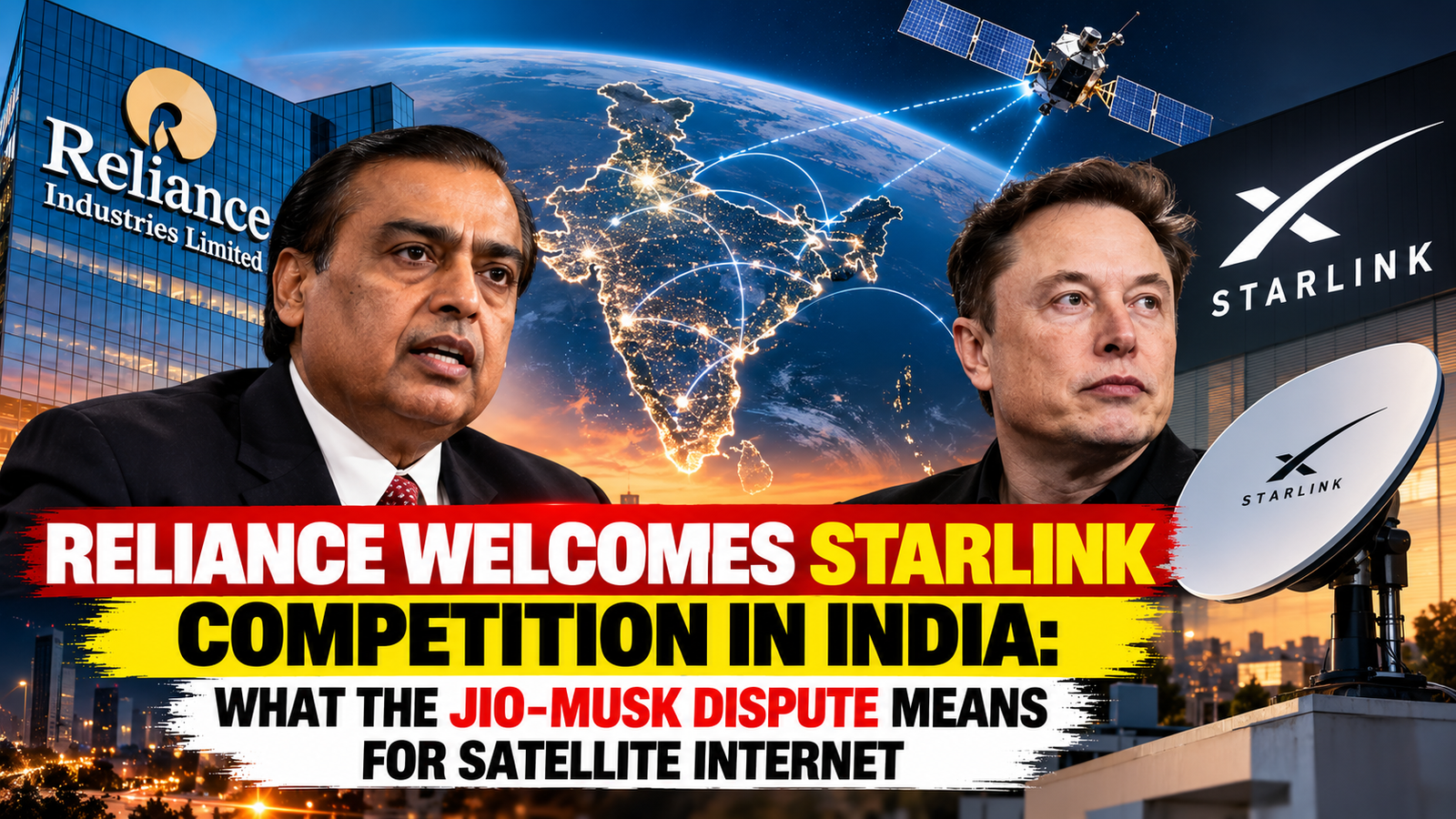
Reliance Industries and Starlink: The competition for India’s satellite internet market has taken a new turn after Reliance Industries (RIL), led by Mukesh Ambani, publicly welcomed competition from Elon Musk’s Starlink. The statement comes amid a public dispute over Starlink’s delayed commercial launch in India and allegations that powerful business interests are obstructing its entry.
Reliance has rejected the suggestion that it fears competition. The company has also highlighted that Jio’s own satellite communication services are awaiting the necessary government clearances.
The development has brought renewed attention to India’s growing satellite broadband market, where domestic and international companies are preparing to compete for customers.
What Did Reliance Say About Starlink?
On October 16, 2026, Reliance Industries said it welcomed competition in satellite communications, including from Starlink. The company emphasised that every operator must follow India’s laws and regulatory policies.
Reliance also referred to India’s investment environment, saying that domestic and international businesses should have opportunities to introduce innovation and improve services for consumers.
The company used Jio’s entry into the Indian telecom market in 2016 as an example of its willingness to compete. According to Reliance, Jio has since grown to more than 530 million customers.
The message was clear: Reliance says it is prepared to compete with new satellite internet providers, provided all companies follow the same regulatory framework.
Why Are Elon Musk and Mukesh Ambani in the Spotlight?
The statement follows criticism from Elon Musk, who has questioned the delays affecting Starlink’s commercial entry into India.
Musk accused powerful business interests of attempting to protect existing positions in the telecom market. He also criticised arguments suggesting that Starlink would struggle to compete with India’s relatively affordable internet services while simultaneously presenting a threat to established operators.
Musk’s position is that allowing more satellite internet providers into India could increase consumer choice and encourage competition.
Reliance, meanwhile, has maintained that India’s regulatory process applies equally to domestic and foreign applicants. It has also pointed out that Jio’s satellite services are waiting for clearances.
These are competing positions in an ongoing public dispute. Allegations of deliberate obstruction have not, by themselves, established that any company has improperly influenced the approval process.
Why Is Starlink’s Entry into India Important?
India has a large internet user base, but reliable high-speed connectivity can still be difficult to access in some remote and geographically challenging areas.
Traditional broadband networks depend on physical infrastructure such as fibre-optic cables and mobile towers. Building and maintaining these networks can be expensive in sparsely populated locations.
Satellite internet offers another way to connect users. Instead of relying entirely on ground-based networks, compatible equipment communicates with satellites to access internet services.
Starlink, operated by SpaceX, uses a network of low Earth orbit satellites. Their relatively low orbital altitude can help deliver lower latency than many traditional satellite systems.
If commercial services become available under India’s regulatory framework, satellite broadband could offer additional connectivity options for households, businesses, remote facilities and other users who lack dependable conventional internet access.
However, the actual benefits will depend on pricing, equipment costs, coverage, service quality and regulatory approvals.
Jio Satellite Internet Is Also Awaiting Clearances
An important detail in Reliance’s statement is that Jio’s own satellite services are also awaiting government clearances.
This matters because the debate is not limited to a foreign company seeking entry into India. Domestic businesses are also exploring satellite-based connectivity as part of the country’s wider digital infrastructure.
India’s satellite communications market includes several interested operators. These include Starlink, Jio Satellite Communications and Bharti-backed Eutelsat OneWeb.
Although companies have obtained relevant licences or authorisations, the ability to begin commercial operations depends on completing the remaining regulatory and security requirements.
Therefore, receiving a licence does not automatically mean that a satellite internet service can immediately begin serving customers.
What Has the Indian Government Said?
The Indian government has maintained that its telecom and satellite communications approval framework is fair and non-discriminatory.
Communications Minister Jyotiraditya Scindia has also stated that India does not permit monopolies in the satellite communications sector. Government requirements include compliance with security conditions before operators can proceed towards commercial operations.
The regulatory process is particularly important for satellite services because these systems involve communications infrastructure, spectrum management and national security considerations.
At the same time, clear and predictable rules can help businesses plan investments and prepare to launch services.
The central question is whether all applicants can complete the same regulatory requirements through a transparent process.
Starlink vs Jio: How Could Competition Affect Consumers?
If multiple satellite internet providers begin commercial operations, Indian consumers could gain additional choices. However, the effect on prices and service quality will depend on how the market develops.
1. More internet options
Satellite connectivity could provide an alternative for people living in areas where fibre broadband or reliable mobile networks are difficult to access.
2. Potential improvements in service quality
Competition may encourage companies to improve reliability, coverage, customer support and installation services to attract subscribers.
3. Pricing pressure
Jio has built a strong position in India’s telecom market through affordable data services. Starlink and other satellite operators will need to consider local purchasing power, equipment costs and the prices offered by competing services.
Satellite internet should not automatically be assumed to cost less than conventional broadband. Hardware, subscriptions and service availability will all influence affordability.
4. Better connectivity for businesses
Businesses operating in remote areas may benefit from additional options for connecting offices, facilities and field operations.
5. Greater resilience
Satellite links can provide useful communication alternatives in certain locations where ground-based networks are unavailable or disrupted. Their effectiveness during emergencies will depend on equipment, power availability, network capacity and local conditions.
Will Starlink Replace Jio’s Traditional Internet Services?
Not necessarily. Satellite broadband and conventional mobile or fibre internet serve overlapping but different needs.
Fibre connections can offer high speeds and competitive pricing in areas with established infrastructure. Mobile networks provide convenient connectivity across large parts of the country.
Satellite services may be particularly useful where building ground infrastructure is difficult or expensive. They could also complement existing networks rather than replace them.
The future market may therefore include a combination of fibre broadband, mobile internet and satellite connectivity.
For consumers in well-connected urban areas, traditional broadband may remain the more economical option. In remote areas, satellite services could become a more attractive alternative if their pricing and performance meet local needs.
What Happens Next in India’s Satellite Internet Market?
The next major developments will depend on regulatory clearances, security compliance, spectrum-related decisions and the commercial plans of individual operators.
Starlink must complete the remaining requirements before beginning commercial operations in India. Jio’s satellite services and other licensed operators also face their own approval requirements.
Companies will then need to demonstrate that their services can meet customer expectations on price, performance, availability and support.
The public disagreement between Musk and Reliance has increased attention on the sector, but it does not determine when any particular service will launch.
For customers, the most important developments will be confirmed launch dates, subscription prices, equipment costs, coverage information and the practical availability of services.
Final Verdict
Reliance Industries’ statement welcoming Starlink competition highlights the growing importance of satellite internet in India’s digital economy. While Elon Musk has questioned the delays affecting Starlink’s entry, Reliance says it welcomes competition and that Jio’s own satellite services are also awaiting clearances.
The wider issue is how India balances fair market competition, national security requirements and the expansion of digital connectivity.
If operators complete the necessary approvals and introduce competitive services, consumers could gain more options for accessing the internet. However, affordable pricing and reliable performance will ultimately determine whether satellite broadband can make a meaningful difference.
For now, the market’s next phase depends on regulatory decisions and the ability of companies to turn their plans into commercially available services.
