


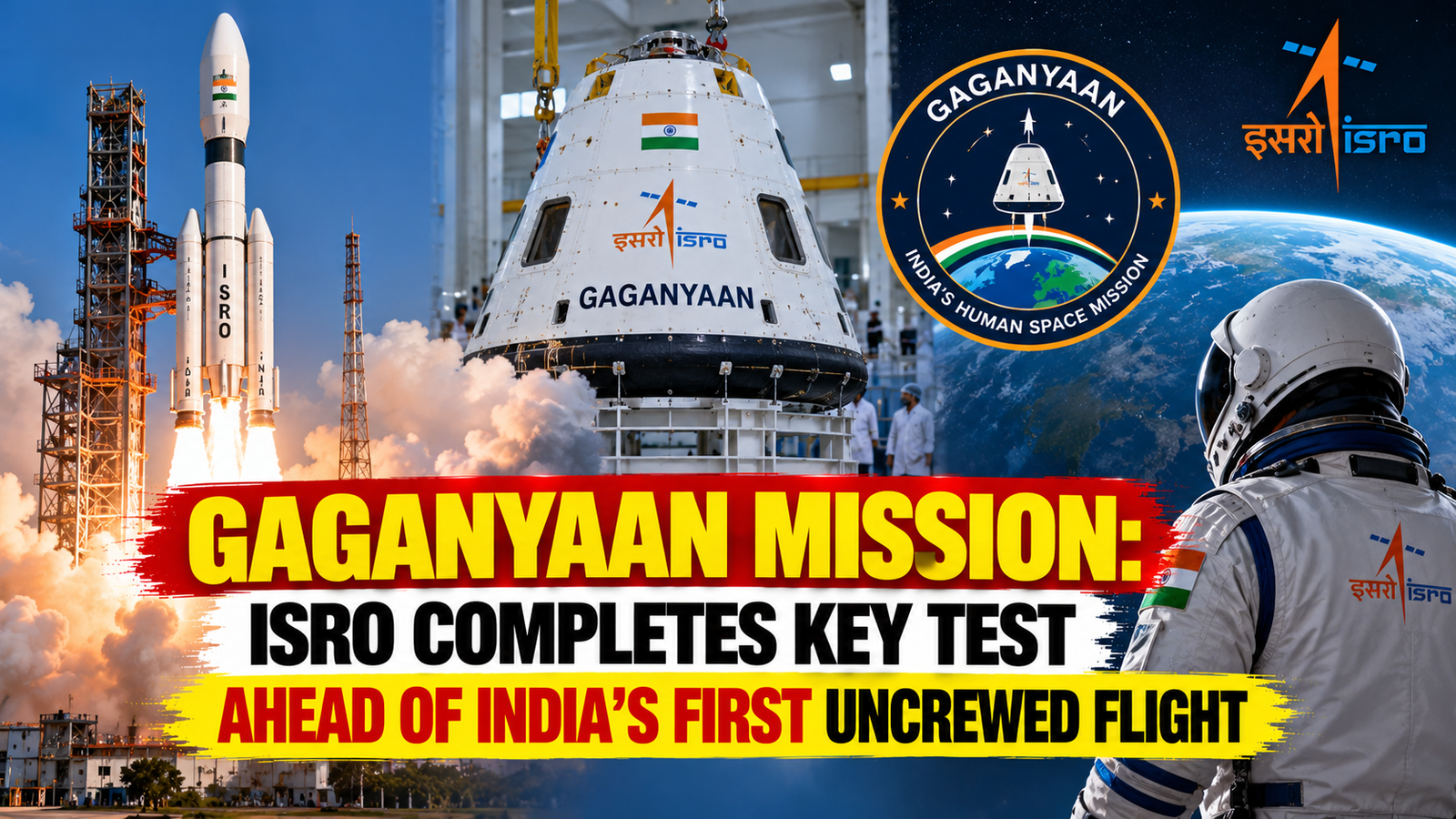
India’s ambitious human spaceflight programme has reached another important milestone. The Indian Space Research Organisation (ISRO) has successfully completed a series of critical Crew Module–Service Module separation tests ahead of the first uncrewed Gaganyaan mission, targeted for 2026.
The tests help verify that the spacecraft’s crew capsule can separate safely from its service module before returning to Earth. This process is essential for astronaut safety during a future crewed mission.
According to ISRO’s official announcement, the tests were conducted using a specially designed setup at the Vikram Sarabhai Space Centre in Thiruvananthapuram, Kerala.
The latest development marks another step towards India’s goal of demonstrating its own human spaceflight capability.
Gaganyaan Mission: Latest Updates on ISRO’s Key Test
The latest Gaganyaan development focuses on the separation system connecting two major parts of the spacecraft: the Crew Module (CM) and the Service Module (SM).
Both modules remain connected during launch and the orbital phase of the mission. Before the spacecraft begins its return journey through Earth’s atmosphere, the crew module must separate from the service module in a carefully controlled sequence.
ISRO’s latest tests were designed to check whether this process works as intended and whether critical systems inside the crew capsule can withstand the mechanical shocks associated with separation.
Key highlights include:
- ISRO completed a series of Crew Module–Service Module separation tests.
- The test setup was established at the Vikram Sarabhai Space Centre in Thiruvananthapuram.
- The tests simulated the separation process, including the disconnection of umbilical connections.
- Critical avionics, navigation, thermal protection, and other systems were evaluated for robustness and shock survivability.
- The results support preparations for the first uncrewed Gaganyaan mission, targeted for 2026.
Read the official ISRO announcement on the separation tests for technical details.
What Is the Gaganyaan Mission?
The Gaganyaan mission is India’s human spaceflight programme, developed to demonstrate the country’s ability to send astronauts into space and bring them safely back to Earth.
The planned crewed mission aims to carry three astronauts to an orbit approximately 400 kilometres above Earth for a mission lasting around three days. The crew module is then expected to return and splash down in Indian sea waters.
The programme involves much more than launching a rocket. ISRO must validate the launch vehicle, spacecraft systems, crew escape arrangements, environmental controls, navigation equipment, parachutes, and recovery operations.
The first uncrewed flights are intended to test the systems before astronauts travel aboard the spacecraft.
For an overview of the programme, visit the official ISRO Gaganyaan Mission page.
Why Is the Crew Module–Service Module Separation Test Important?
Spacecraft separation is a critical stage of a human spaceflight mission. The crew module and service module perform different functions, so the spacecraft must separate them at the correct time.
1. Safe Return to Earth
The crew module is designed to bring astronauts back to Earth. Before atmospheric re-entry, it must separate from the service module so that the capsule can continue its return sequence.
A problem during separation could affect the spacecraft’s ability to complete this phase safely. Testing the system on the ground helps engineers identify and address potential weaknesses.
2. Reliable Separation Mechanisms
The separation process involves multiple precisely sequenced events, including pyrotechnic devices and jettisoning systems. These mechanisms must operate in the correct order.
The recent tests simulated the overall assembly and the severing of several connections between the two modules. This helps ISRO assess the design and reliability of the separation system.
3. Protection of Critical Spacecraft Electronics
Spaceflight hardware must withstand mechanical disturbances during major events. ISRO reported that the tests demonstrated the robustness and shock survivability of important systems inside the crew module.
These include avionics and inertial navigation systems, which help the spacecraft manage essential electronic and navigation functions.
4. Better Confidence Before Human Flights
Ground tests are an important part of preparing a spacecraft for human use. Successful testing provides evidence that individual systems and mechanisms are designed to work under the conditions they may encounter during a mission.
However, completing this test does not by itself mean the entire Gaganyaan spacecraft is ready for a crewed flight. Other qualification tests and mission preparations remain important.
What Systems Were Evaluated During the Latest Test?
ISRO identified several critical systems involved in the recent separation test.
| System | Why It Matters |
|---|---|
| Avionics systems | Support spacecraft electronics and control functions |
| Inertial navigation systems | Help determine the spacecraft’s orientation and motion |
| Thermal protection system | Helps protect the crew module during the extreme heat of re-entry |
| Deployable umbilical shield | Protects the relevant connection area during separation |
| Crew Module Uprighting System mechanisms | Support the capsule’s correct orientation after splashdown |
| Thermal and humidity control systems | Help manage conditions inside the crew module |
The testing also assessed the separation system’s overall design adequacy and the effects associated with disconnecting the modules’ umbilical connections.
These components serve different purposes, but their reliable operation is important for the spacecraft’s overall mission performance.
When Will India’s First Uncrewed Gaganyaan Mission Launch?
The first uncrewed Gaganyaan mission, known as G1, is targeted for launch in 2026, according to ISRO’s October 2026 announcement.
The mission is intended to validate important technologies and systems before the first crewed flight. The uncrewed test flight is expected to include Vyommitra, ISRO’s humanoid robot developed for the programme.
The mission will help engineers assess how the spacecraft and its systems perform during an actual flight, complementing the ground tests conducted during development.
The target date should not be treated as a confirmed launch day. The actual schedule may depend on test results, technical readiness, and other mission requirements.
For the latest official programme information, readers can follow ISRO’s website.
What Is Vyommitra and Why Is It Important?
Vyommitra is a humanoid robot developed by ISRO to support the uncrewed phase of the Gaganyaan programme.
Its role is to help evaluate aspects of the crew module’s environment and onboard systems before astronauts fly. A robotic passenger can provide useful information about spacecraft operations without placing a human crew at risk during the initial validation missions.
The uncrewed flights are therefore an important step in the broader process of preparing for human spaceflight. They allow ISRO to gather operational data and assess whether the spacecraft performs as expected.
India’s Human Spaceflight Plans Beyond Gaganyaan
Gaganyaan is also part of India’s broader ambitions in space exploration. Developing human-rated launch vehicles, spacecraft, astronaut training facilities, and mission-control capabilities can strengthen the country’s ability to undertake more advanced space missions.
The Indian government has also outlined plans for the Bharatiya Antariksh Station, India’s proposed space station, with operationalisation targeted for 2035. The country has separately stated its ambition to send an Indian astronaut to the Moon by 2040.
These are longer-term goals rather than completed achievements. Their progress will depend on technology development, testing, funding, and future mission decisions.
The Gaganyaan programme provides a foundation for building the technical capabilities needed for such future projects.
How Does the Latest Test Bring India Closer to Human Spaceflight?
Human spaceflight requires many systems to work together reliably. A rocket must place the spacecraft into the intended orbit, onboard systems must operate correctly, and the crew capsule must return safely.
The latest separation tests address one part of this sequence. They help engineers verify the mechanism that disconnects the crew module from the service module before re-entry.
Other aspects of the programme, including parachute and deceleration systems, crew escape arrangements, life-support systems, and recovery operations, are also important to mission safety.
The successful completion of a particular test is encouraging progress, but the wider programme requires multiple stages of validation before astronauts can fly.
Frequently Asked Questions (FAQs)
1. What is the latest news about the Gaganyaan mission?
ISRO completed a series of Crew Module–Service Module separation tests on the Gaganyaan spacecraft system. The tests support preparations for the first uncrewed mission, targeted for 2026.
2. Why did ISRO conduct the separation test?
The test was designed to validate the separation system connecting the crew module and service module and assess the robustness of critical systems exposed to separation-related shocks.
3. Where was the Gaganyaan separation test conducted?
ISRO established the test setup at the Vikram Sarabhai Space Centre in Thiruvananthapuram, Kerala.
4. When is India’s first uncrewed Gaganyaan mission planned?
The G1 uncrewed mission is targeted for 2026. The target is subject to technical readiness and further mission preparations; it is not a confirmed launch date.
5. Will astronauts travel on the first Gaganyaan test flight?
The first Gaganyaan mission, G1, is planned as an uncrewed flight. It is intended to validate key technologies before a crewed mission.
6. What is the role of Vyommitra in Gaganyaan?
Vyommitra is ISRO’s humanoid robot developed to support the uncrewed phase of the programme and help evaluate spacecraft systems and conditions.
7. How many astronauts will the planned Gaganyaan crewed mission carry?
The planned mission aims to carry three astronauts to an orbit approximately 400 kilometres above Earth for around three days before returning them safely.
8. Does the successful separation test mean Gaganyaan is ready for a crewed launch?
No. It is one important milestone, but other systems, qualification activities, and mission preparations must also be completed before a crewed flight.
9. Where can readers find official Gaganyaan updates?
Readers can check the ISRO website and the official Gaganyaan Mission page for programme information and announcements.
Conclusion
ISRO’s successful completion of the Crew Module–Service Module separation tests represents another important milestone in India’s Gaganyaan programme. The tests help verify a mechanism required for the crew capsule’s return to Earth and assess the robustness of several critical onboard systems.
With the first uncrewed mission targeted for 2026, ISRO continues to prepare and validate technologies needed for India’s human spaceflight ambitions. The upcoming flight and further qualification work will be important in determining the programme’s readiness for a future crewed mission.
Gaganyaan is not just a rocket launch project. It is a complex effort to develop the spacecraft, safety systems, infrastructure, and operational capabilities needed to send Indian astronauts into space and bring them home safely.
