


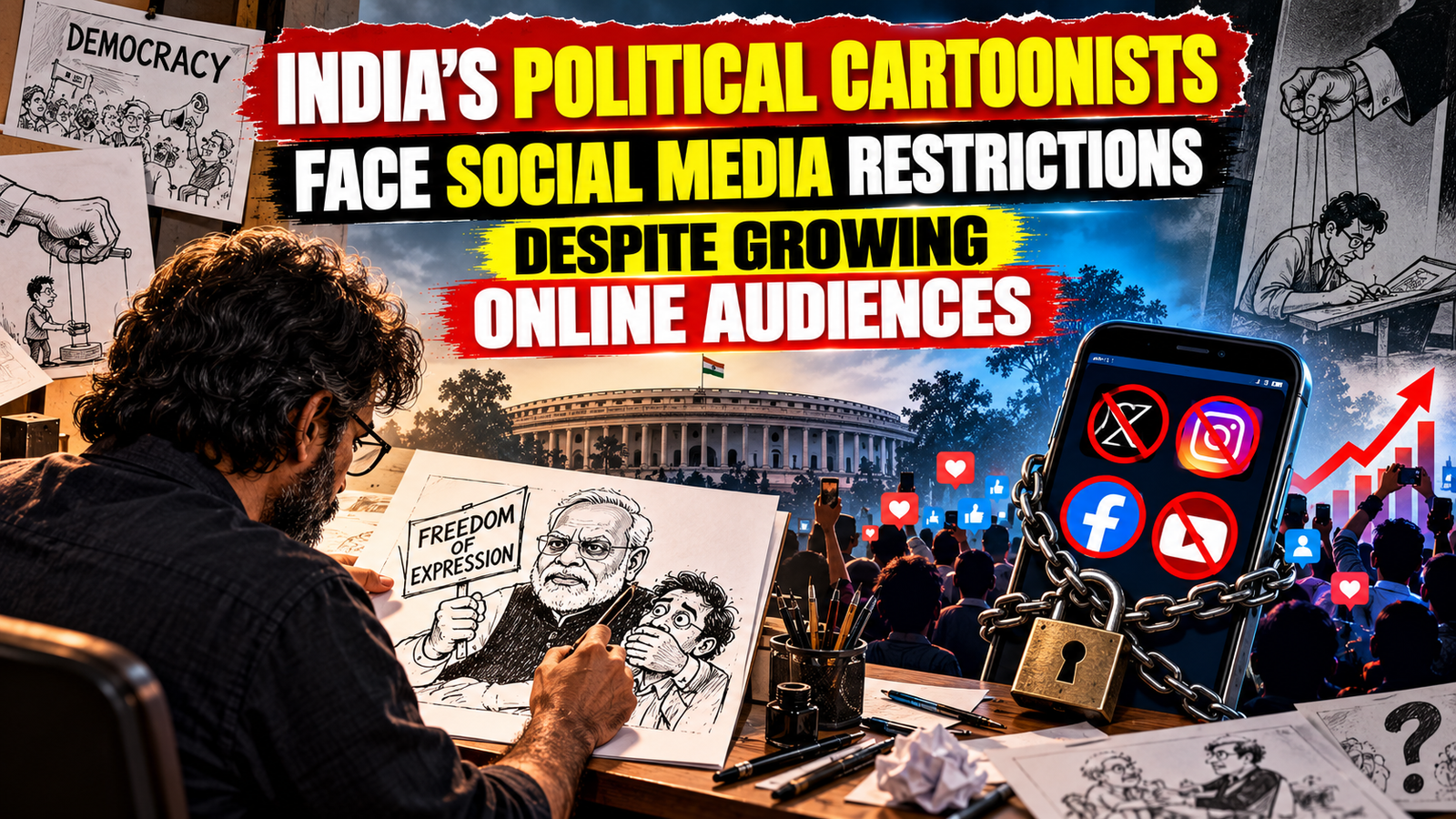
India’s political cartoonists have increasingly turned to social media to share their work, reach new audiences and comment on the country’s political developments. However, recent restrictions on the Instagram accounts and posts of prominent cartoonists have raised questions about online expression, content regulation and the future of political satire.
According to a BBC report, cartoonist Satish Acharya’s Instagram profile was temporarily restricted in India twice within three weeks. Another cartoonist, Manjul, also reported that Instagram restricted a post criticising the Election Commission of India’s controversial voter-roll revision.
The incidents have renewed debate over how social media platforms respond to government requests under India’s Information Technology Rules. While authorities maintain that content regulations help address unlawful material, critics argue that opaque restrictions can affect legitimate political commentary.
The issue extends beyond individual artists. For independent cartoonists, social media has become an important way to publish their work without depending entirely on newspaper editors or traditional media organisations. When a platform restricts their content or makes their profiles inaccessible, however, creators can lose direct access to the audiences they have spent years building.
Key Highlights
- Indian political cartoonists Satish Acharya and Manjul have faced reported restrictions on Instagram.
- Acharya’s account was reportedly inaccessible to users in India during two separate periods.
- Manjul’s post criticising the Election Commission’s voter-roll revision was also restricted.
- Meta told the BBC that it may restrict accounts or content to comply with India’s IT Rules but did not explain the specific cases.
- Independent cartoonists rely on social media to publish work and reach audiences beyond traditional newsrooms.
- The incidents have renewed discussion about political satire, content moderation and transparency in India.
Why Are Indian Cartoonists Facing Social Media Restrictions?
Political cartoonists use illustrations, humour, irony and visual metaphors to comment on public policy, elections and the actions of political leaders. Their work can communicate criticism in a format that is easy to share and understand.
Social media has expanded the reach of this work, allowing artists to publish cartoons directly to followers without waiting for a newspaper or magazine to accept them.
However, this independence also creates a new challenge: the platform hosting the content controls whether it remains accessible.
The BBC report describes cases involving Satish Acharya and Manjul, whose work was restricted on Instagram. These cases have raised concerns because the artists said they received little or no explanation for the specific restrictions.
Meta told the BBC that it may temporarily restrict accounts to comply with India’s IT Rules. The company did not provide a specific explanation for the restrictions affecting Acharya’s account or Manjul’s post.
The reported cases therefore highlight a broader issue for online creators: when content is restricted, users may struggle to understand the decision, challenge it or determine how long the restriction will remain in place.
The available reporting does not establish that every restriction on political cartoons is politically motivated. It does, however, document concerns about transparency and the impact of content restrictions on political expression.
Satish Acharya’s Instagram Account Was Restricted Twice
Satish Acharya is a prominent Indian political cartoonist whose work has circulated widely on social media.
According to the BBC, his Instagram account was first restricted in India from September 28 to October 6. During that period, users in India could not find his profile through Instagram search or access it through a direct web link.
People attempting to access the profile reportedly saw a notice indicating that it was unavailable under India’s Information Technology Rules.
Acharya contacted Meta, Instagram’s parent company, but said he did not receive a response. He was preparing to pursue legal action when the account became accessible again in early October.
The BBC subsequently reported that the account was restricted for a second time for three days in late October.
Acharya told the BBC that Meta’s platforms had been limiting the reach of his cartoons for years, but that losing access to his entire profile was particularly upsetting.
The case illustrates the difference between a post receiving less visibility and an account becoming inaccessible to users in a particular country. For a creator who relies on social media to distribute work, either situation can affect audience engagement, but a profile-level restriction can have a much wider impact.
The report does not establish a definitive explanation for why Acharya’s account was restricted on either occasion.
Why Was Manjul’s Cartoon Restricted?
Manjul, another Indian political cartoonist, faced a separate restriction involving a post criticising the Election Commission of India’s revision of voter rolls.
The cartoon used satire to question the removal of large numbers of names from electoral rolls. The BBC report linked the controversy to a wider debate over the voter-list revision exercise and its implications for eligible voters.
Manjul’s full Instagram profile reportedly remained accessible, unlike Acharya’s account, which was temporarily blocked in India.
The distinction matters because content restrictions can operate at different levels. A platform may restrict an individual post, limit access to an account in a particular country or make a profile unavailable more broadly.
The BBC reported that Meta did not provide a specific explanation for the restriction affecting Manjul’s post.
The case has contributed to questions about how platforms decide which political content must be restricted, what information they provide to affected users and what avenues are available for challenging such decisions.
What Are India’s IT Rules, and How Do They Affect Online Content?
India’s Information Technology Rules provide a framework governing certain aspects of digital platforms and online content. Under applicable legal provisions, authorities and courts can direct platforms to remove or restrict access to specified material.
The government has defended content regulation as a means of addressing unlawful material and other risks. Critics, however, argue that restrictions can affect lawful expression when the reasons are unclear or when users have limited information about the process.
The cartoonists’ cases have brought this debate into focus because political satire often involves criticism, exaggeration and humour directed at institutions or people in positions of authority.
The legal status of a particular cartoon depends on the content, the relevant law and the circumstances of the restriction. It would therefore be inaccurate to assume that every restricted cartoon is lawful or that every restriction is justified.
Transparency is central to the debate. Users need meaningful information about why a post has been restricted, which legal provision applies and whether the decision can be challenged.
In the cases described by the BBC, the platform did not publicly explain the specific reasons for the restrictions.
Nearly 195,000 Content-Restriction Orders Reported Between March and July
The BBC report also discussed the broader scale of government requests to restrict online content.
According to figures reported by The Indian Express and obtained through a Right to Information request, government agencies sent nearly 195,000 blocking and content-restriction orders to platforms including Instagram, Facebook and YouTube between March and July through the federal government’s Sahyog portal.
The BBC noted that the figures did not show how many posts were ultimately restricted or removed, and that it had not seen the original response to the information request.
This distinction is important. The number of orders cannot automatically be treated as the number of individual posts removed, accounts blocked or separate creators affected.
The figures nevertheless illustrate why transparency around content regulation has become a significant public issue. Without detailed information about the orders, the material involved and the outcomes, it is difficult to assess the full effect of restrictions on online speech.
The report also cited technology policy expert Prateek Waghre, who said some platforms appeared more willing to comply with government requests than others. However, the BBC noted that limited public data makes direct comparisons difficult.
How Social Media Changed Political Cartooning in India
Political cartooning has a long history in Indian journalism. For decades, newspapers and magazines provided artists with a platform to comment on politics, public policy and social change.
The growth of digital media has changed how cartoonists create and distribute their work.
Direct access to audiences
Artists can now publish cartoons directly to social media accounts and build communities around their work. They no longer need to rely entirely on newspaper editors or traditional publishers to reach readers.
Faster distribution
A cartoon can circulate widely within hours of publication. Followers can share, discuss and respond to it, giving the creator immediate feedback.
Greater independence
Independent cartoonists can address subjects that might not fit the editorial priorities of a traditional publication. This can provide more room for individual expression, although it does not remove the risks associated with platform moderation.
New dependence on technology companies
The same platforms that help creators build audiences also control access to those audiences. Restrictions, account suspensions, algorithmic changes and reduced visibility can affect a creator’s ability to distribute work.
This creates a tension at the heart of digital publishing: social media can increase creative independence while making creators more dependent on private technology companies.
India’s Long History of Political Cartoons and Censorship
Political satire in India predates social media by many decades.
One of the best-known figures in Indian cartooning was R. K. Laxman, whose Common Man character became a recognisable observer of political and social life.
Cartoonists have also faced restrictions throughout the country’s history. During the Emergency of the 1970s, press censorship affected political commentary, and cartoonist Abu Abraham continued producing work despite censorship.
In 2012, cartoonist Aseem Trivedi was arrested on sedition charges over cartoons that allegedly mocked the Indian Constitution. The charges were later dropped.
These historical examples show that disagreements over political cartoons and the boundaries of expression did not begin with Instagram or other modern platforms.
What has changed is the mechanism through which content can be restricted. In the past, newspaper editors, publishers and government censorship played prominent roles. Today, digital platforms can also control the visibility of content, sometimes in response to legal requests.
The recent cases involving Acharya and Manjul have therefore brought an older debate into a new technological environment.
Why Independent Cartoonists Are Particularly Vulnerable
Independent artists often lack the institutional support available to journalists working for established media organisations.
A cartoonist with a large social media following may depend on one platform for much of their reach, audience interaction and professional visibility. If the platform becomes inaccessible, the creator may have few immediate alternatives with comparable reach.
The BBC report also discussed Rachita Taneja, the creator of the comic series Sanitary Panels. Taneja said her career would not have existed without the internet, while describing social media as a double-edged sword.
Her comments reflect a wider challenge for digital creators: platforms offer access to audiences but remain commercial services with their own policies and obligations.
When creators depend heavily on a single platform, restrictions can affect their ability to communicate even if they continue producing work.
For this reason, some artists and observers emphasise the importance of independent websites, newsletters, multiple social media channels and communities that are not dependent on one service.
These options cannot guarantee that content will remain unrestricted, but they can reduce the risk of losing all audience access when a single account becomes unavailable.
Could Content Restrictions Lead to Self-Censorship?
The effects of content moderation may extend beyond the posts that are directly restricted.
The BBC report quoted newspaper cartoonist Sandeep Adhwaryu, who said artists may soften captions, avoid certain subjects or reconsider cartoons before submitting them. He warned that such self-censorship can become normalised even without explicit instructions.
This concern is not limited to cartoonists. Journalists, comedians, writers and other creators may also consider the possible consequences of publishing controversial material.
Self-censorship is difficult to measure because it involves decisions not to publish. A creator may abandon an idea, change a caption or choose a less controversial subject without anyone else knowing.
However, the possibility matters for public debate. If creators believe that certain subjects are too risky to address, audiences may encounter a narrower range of criticism and commentary.
At the same time, individual publishing decisions can have many causes, including editorial judgement, personal preference and legal concerns. Not every decision to avoid a subject can be attributed to government action or platform restrictions.
The key question is whether content rules are sufficiently clear and transparent to allow creators to understand the boundaries of permissible expression.
How Cartoonists Are Supporting One Another
The BBC report also described how cartoonists have supported colleagues whose accounts or posts were restricted.
When Acharya’s account was first blocked, Rachita Taneja created a cartoon expressing solidarity with him.
Such responses demonstrate how online communities can help creators draw attention to restrictions and keep a discussion alive even when an individual account becomes inaccessible.
Solidarity can take different forms, including sharing a creator’s work on alternative platforms, raising questions about a restriction, preserving published material and supporting efforts to seek clarification.
For independent artists, these networks can help reduce isolation and maintain visibility during disputes with platforms.
However, the longer-term effects of these efforts depend on whether creators can restore access, reach audiences through other channels and obtain meaningful explanations for restrictions.
What Happens Next for India’s Political Cartoonists?
The cases involving Satish Acharya and Manjul highlight several unresolved questions about the future of political satire online.
First, creators need clearer explanations when their accounts or posts are restricted. Transparency can help users understand whether a decision was based on a legal order, a platform policy or another reason.
Second, platforms and regulators face questions about how restrictions can be reviewed and challenged. Accessible procedures are particularly important when a decision affects a creator’s primary publishing channel.
Third, independent cartoonists may need to diversify how they distribute their work. Maintaining an independent website, using multiple platforms and developing direct audience relationships can reduce dependence on a single service.
Finally, public discussion about political expression will continue to involve competing considerations, including legal compliance, safety, the rights of creators and the responsibilities of technology companies.
The available reporting does not resolve these questions, nor does it establish the specific legal basis for every restriction discussed. It does show why creators, platforms and regulators are under pressure to explain how online content decisions are made.
Frequently Asked Questions (FAQs)
1. Why are Indian political cartoonists facing restrictions on Instagram?
The BBC reported that Satish Acharya’s account was temporarily restricted in India and that a post by Manjul was also restricted. Meta said it may restrict content to comply with India’s IT Rules but did not explain the specific reasons for these cases.
2. Who is Satish Acharya?
Satish Acharya is an Indian political cartoonist whose work comments on political leaders, public policy and current affairs. He has built an audience through online platforms, including Instagram.
3. Why was Manjul’s cartoon restricted?
The BBC reported that Instagram restricted a post by Manjul criticising the Election Commission’s voter-roll revision. The platform did not provide a specific explanation for the restriction in its response to the BBC.
4. What are India’s IT Rules?
India’s Information Technology Rules form part of the legal framework governing digital platforms and online content. Applicable provisions allow authorities or courts to direct the restriction or removal of specified material.
5. How has social media changed political cartooning?
Social media allows cartoonists to publish directly to audiences, distribute work quickly and build communities without relying entirely on traditional media. However, creators can also become dependent on platform policies and content moderation decisions.
6. What is self-censorship in political cartooning?
Self-censorship occurs when creators change, soften or avoid content because they anticipate negative consequences. The BBC report quoted a cartoonist who said artists sometimes reconsider captions and subjects before publication.
7. Can creators avoid depending on one social media platform?
Creators can consider maintaining their own websites, newsletters and accounts across multiple platforms. These steps may help preserve access to audiences, although they cannot guarantee uninterrupted distribution.
8. What is the main issue raised by these restrictions?
The central issue is how platforms and authorities balance legal compliance with transparent decision-making and the ability of artists to publish political commentary. The specific reasons behind the restrictions discussed in the BBC report remain unexplained publicly.
Conclusion
India’s political cartoonists have used social media to reach audiences beyond traditional newspapers and publishing organisations. For independent artists such as Satish Acharya and Manjul, these platforms have created opportunities to publish political satire directly to readers.
However, the reported restrictions on Acharya’s Instagram account and Manjul’s post highlight the vulnerability that comes with depending on privately operated platforms.
India’s IT Rules provide a mechanism for restricting certain online content, while critics argue that unclear explanations and limited transparency can affect legitimate political expression. Meta has said it may restrict content to comply with the rules, but did not provide specific reasons for the cases covered in the BBC report.
The wider debate is not simply about individual cartoons. It concerns how digital platforms make content decisions, how users can challenge them and how independent creators can continue reaching audiences.
Political cartooning has adapted to changing media environments before. Its future online will depend partly on whether artists can preserve their independence while navigating the legal and commercial systems that govern digital publishing.
