


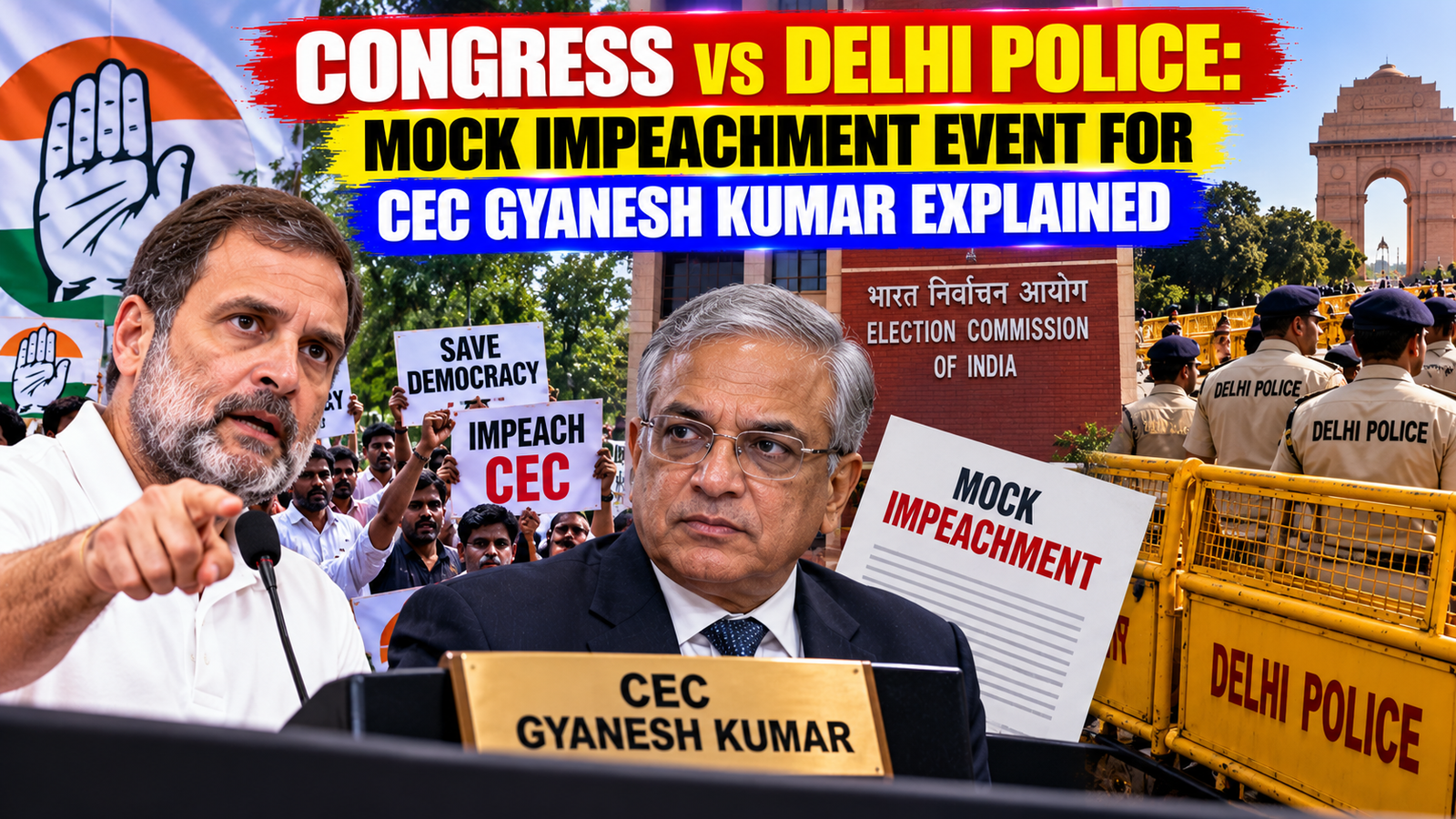
A political dispute has emerged in New Delhi after Congress accused authorities of obstructing a planned mock impeachment event against Chief Election Commissioner Gyanesh Kumar. The proposed event is part of a wider campaign by the opposition INDIA bloc concerning electoral roll revisions and alleged irregularities.
The controversy has also drawn attention to Delhi Police’s clarification regarding permissions for a November 1 rally at Ramlila Maidan. While Congress alleged that preparations for its events faced interference, police sources maintained that permission for the main rally had not been withdrawn.
The development has raised questions about protest permissions, the Election Commission’s role, and the legal process for removing a Chief Election Commissioner. Here is what happened, why the issue matters, and what may happen next.
What Happened in the Congress and Delhi Police Dispute?
On October 27, 2026, Congress alleged that permission for a planned public impeachment-style event against Chief Election Commissioner Gyanesh Kumar had been denied. The event was intended as a precursor to a larger INDIA bloc rally scheduled for November 1 at Ramlila Maidan in New Delhi.
Congress general secretary KC Venugopal said the proposed event was initially planned at the government-run Ashoka Hotel. According to the party, permission for using the venue was subsequently withdrawn, and preparations at Ramlila Maidan also faced obstruction.
However, Delhi Police offered a different clarification. Police sources stated that permission for the November 1 rally at Ramlila Maidan remained valid. They also said that arrangements for the proposed mock Parliament at Ashoka Hotel depended on the hotel’s decision because the venue’s premises were privately managed.
The disagreement centers on the arrangements for the October 30 event, rather than a confirmed cancellation of the November 1 rally. The distinction is important when understanding the competing claims.
Why Is Congress Planning a Mock Impeachment of Gyanesh Kumar?
Congress and other opposition parties have criticized the functioning of the Election Commission of India, particularly over the Special Intensive Revision (SIR) of electoral rolls. Opposition leaders have raised concerns about voter deletions and alleged irregularities in the electoral process.
The proposed mock impeachment is intended as a public demonstration of the opposition’s objections to Chief Election Commissioner Gyanesh Kumar. The event was planned to include a mock parliamentary proceeding in which participating leaders would discuss their allegations and demands.
Congress has described the initiative as part of a wider campaign to protect electoral integrity and raise concerns about voter rights. These statements represent the party’s position and should be distinguished from independently established findings.
The Election Commission has defended its procedures in legal proceedings. The dispute therefore involves competing claims about electoral administration, accountability, and the safeguards governing voter registration.
What Did Delhi Police Say About the Rally Permission?
Delhi Police clarified that it had not withdrawn the no-objection certificate issued for booking Ramlila Maidan for the November 1 rally. The permission covered the period from October 25 to November 3, subject to the required approvals and conditions.
Police sources also stated that permission for the proposed mock Parliament at Ashoka Hotel depended on the venue’s management. This clarification addressed the Congress allegation that police had prevented the event from taking place at the hotel.
The police imposed several conditions for the November 1 gathering. These included installing CCTV cameras at strategic locations, arranging adequate water and toilet facilities, and deploying volunteers to help manage participants.
The rally was also required to conclude by 5 p.m. Organizers were instructed to prevent speeches that could disturb communal harmony and to ensure an orderly dispersal of attendees.
These conditions concern crowd management and public order. Whether individual allegations about interference with preparations are justified requires examination of the specific permissions, communications, and events involved.
When and Where Will the INDIA Bloc Hold Its Protest?
The INDIA bloc’s planned protest program includes a mock public impeachment proceeding against Gyanesh Kumar on October 30, 2026, followed by a larger rally and march on November 1.
After the dispute over the Ashoka Hotel venue, Congress announced that the mock proceeding would be held at party president Mallikarjun Kharge’s residence. The change was reported on October 27.
The November 1 rally is planned for Ramlila Maidan in New Delhi. Congress has invited leaders and members of opposition parties to participate in the program.
The events are intended to draw attention to opposition concerns about the electoral process. However, the final arrangements and attendance may depend on coordination between the organizers, venue authorities, and the relevant public agencies.
Readers should check official announcements for any changes to the venue, schedule, or participation arrangements.
What Is the Special Intensive Revision of Electoral Rolls?
The Special Intensive Revision, commonly called SIR, is an exercise conducted to review and update electoral rolls. Such revisions are intended to improve the accuracy of voter lists by verifying entries and addressing eligible additions, deletions, or corrections.
Electoral rolls are important because they determine who is registered to vote in an election. Accurate records help election authorities administer voting and maintain reliable voter lists.
However, revision exercises can generate public debate when voters or political parties raise concerns about documentation requirements, missing names, or the process used to identify ineligible entries.
Congress and other opposition parties have questioned aspects of the SIR process. The Election Commission has defended its procedures, and specific allegations must be assessed using official records, court filings, and verified evidence rather than political statements alone.
Can a Chief Election Commissioner Be Removed Through a Public Impeachment Event?
A public mock impeachment is a political demonstration, not a formal constitutional removal process. It cannot itself remove the Chief Election Commissioner from office.
Under India’s constitutional framework, the Chief Election Commissioner can be removed through a process similar to that applicable to a Supreme Court judge. Removal requires action by Parliament under the prescribed constitutional procedure, including special majorities in both Houses on grounds of proved misbehaviour or incapacity.
A political rally or mock parliamentary proceeding may communicate public or political opposition to an officeholder. However, it has no independent legal power to change that person’s official status.
This distinction is central to understanding the planned event. The opposition’s proposed proceeding is intended to express its objections and demands, while any formal removal would require the constitutional process to be followed.
How Could the Dispute Affect India’s Political Debate?
The dispute has placed electoral administration and protest permissions at the center of a wider political debate. Opposition parties argue that their concerns about voter lists and the Election Commission require public scrutiny.
The authorities, meanwhile, have referred to the permissions and conditions governing the planned rally. The difference between the parties’ accounts illustrates why it is important to examine official documents and distinguish between allegations and confirmed decisions.
The controversy may also draw attention to the relationship between political protest and public-order requirements. Democratic systems provide space for peaceful political expression, while authorities must manage public gatherings in accordance with applicable laws and permissions.
The wider debate will depend on the evidence presented by the parties, any relevant judicial proceedings, and how the planned events proceed.
Conclusion
The Congress–Delhi Police dispute over the mock impeachment event involving Chief Election Commissioner Gyanesh Kumar has highlighted tensions surrounding electoral roll revisions and opposition protests.
Congress alleged that arrangements for its October 30 event faced restrictions, while Delhi Police clarified that permission for the November 1 rally at Ramlila Maidan had not been withdrawn. The proposed mock proceeding was subsequently reported to be moving to Mallikarjun Kharge’s residence.
The event is a political demonstration rather than a formal constitutional impeachment. Any removal of the Chief Election Commissioner would require the prescribed parliamentary process.
As the planned protests approach, verified updates from Congress, Delhi Police, the Election Commission, and relevant official documents will help clarify developments.
Frequently Asked Questions (FAQs)
1. Why is Congress planning a mock impeachment of Gyanesh Kumar?
Congress and other INDIA bloc parties are protesting over concerns about the Special Intensive Revision of electoral rolls and alleged electoral irregularities. The mock proceeding is intended to publicly communicate their objections and demand accountability.
2. What did Delhi Police say about the November 1 rally?
Delhi Police stated that permission for the Ramlila Maidan rally had not been withdrawn. The approval remained subject to conditions relating to public safety, crowd management, and the required venue permissions.
3. When is the mock impeachment event scheduled?
The event was planned for October 30, 2026. Following the dispute over the original venue, Congress announced that it would be held at Mallikarjun Kharge’s residence.
4. What is the Special Intensive Revision of electoral rolls?
The Special Intensive Revision is an exercise to review and update voter lists. It aims to verify electoral records, although the process has faced political debate over alleged deletions and documentation requirements.
5. Can a public impeachment remove the Chief Election Commissioner?
No. A mock public impeachment is a political demonstration and does not have legal authority to remove the Chief Election Commissioner. Removal must follow the constitutional procedure involving Parliament.
