


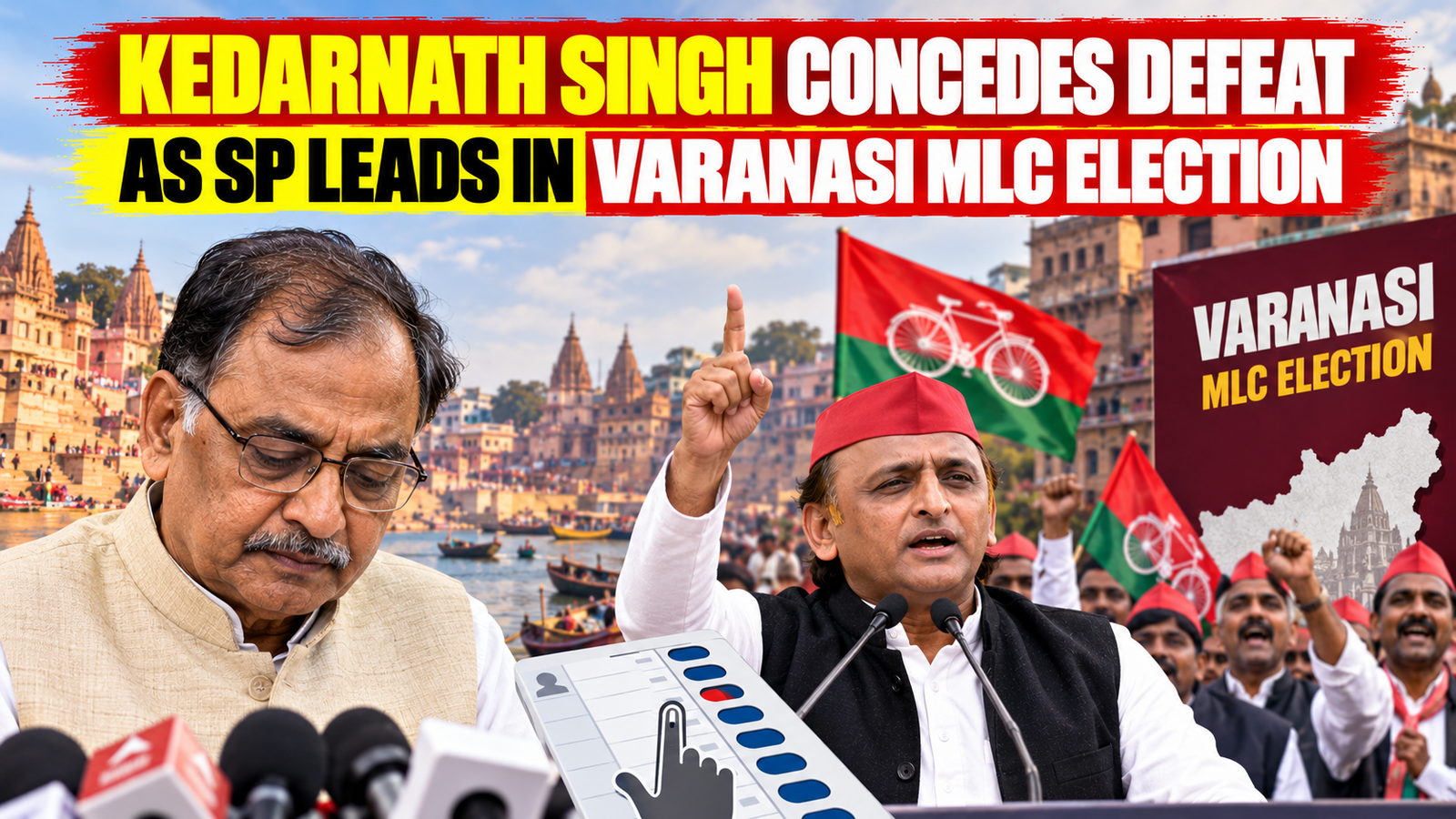
The Kedarnath Singh defeat in the Varanasi MLC election has emerged as a significant political development in Uttar Pradesh. Bharatiya Janata Party (BJP) candidate Kedarnath Singh conceded defeat in the Varanasi Graduates’ constituency election after Samajwadi Party (SP) candidate Ashutosh Sinha established a substantial lead during vote counting.
In a Facebook post, Singh thanked voters for their support and said he accepted the public mandate with humility. His concession came after an extended counting process involving second-preference votes.
According to reports published on October 29, 2026, Sinha had secured approximately 50,462 votes against Singh’s 33,674, giving the Samajwadi Party candidate a lead of around 16,788 votes in the reported count. Some reports cited a lead of approximately 16,984 votes as counting progressed.
The contest is politically important because Varanasi is represented in the Lok Sabha by Prime Minister Narendra Modi. However, the MLC election involves a specific electorate of registered graduates, so its outcome should not be treated as a direct measure of the voting preferences of the entire city.
Why Did Kedarnath Singh Concede Defeat in Varanasi?
Kedarnath Singh conceded defeat after Samajwadi Party candidate Ashutosh Sinha built a substantial advantage during the counting process.
The counting of votes in the Varanasi Graduates’ constituency began on October 27 and continued through an extended process involving preference votes. As the SP candidate’s lead widened, Singh acknowledged that the result had not matched his expectations.
In his Facebook message, the BJP candidate thanked voters for their affection, cooperation and trust. He said he accepted the public mandate in a spirit of humility and democratic responsibility.
His statement also conveyed that electoral defeat would not end his commitment to public service or to the concerns of the graduates’ constituency.
The concession marked an important moment in a closely watched election, although the official result and election certificate remain the authoritative confirmation of the outcome.
Who Is Ashutosh Sinha, the Samajwadi Party Candidate?
Ashutosh Sinha contested the Varanasi Graduates’ constituency seat for the Samajwadi Party.
He emerged ahead of BJP candidate Kedarnath Singh during the vote-counting process, securing a substantial lead in the reported preference-vote figures.
The contest was closely followed because the Samajwadi Party was seeking to retain its position in the Varanasi division and strengthen its standing ahead of the 2027 Uttar Pradesh Assembly election.
Sinha’s performance also contributed to the broader political discussion about the BJP and SP’s relative strength in the state.
The final significance of his victory depends on the certified result and the wider electoral context. The graduates’ constituency represents a specialised voter group rather than the entire electorate of Varanasi.
What Were the Vote Counts in the Varanasi Graduates’ Election?
Reports published on October 29 provided the following figures during the counting process:
| Candidate | Party | Reported votes |
|---|---|---|
| Ashutosh Sinha | Samajwadi Party | 50,462 |
| Kedarnath Singh | BJP | 33,674 |
The reported difference was approximately 16,788 votes. Other updates cited a lead of around 16,984 votes, reflecting changes in the counting figures reported at different times.
These figures relate to the reported counting stage and should not be confused with a final certified tally unless confirmed by the election authorities.
The extended counting process drew attention because preference votes play an important role in determining outcomes in these Legislative Council constituencies.
Why Is the Varanasi MLC Election Important for the BJP?
The result represents a political setback for the BJP in a constituency linked to Prime Minister Narendra Modi’s parliamentary seat.
Varanasi is one of the BJP’s most prominent political centres, making contests in the region particularly significant for the party’s local organisation and campaign strategy.
The loss also raises questions about the party’s ability to mobilise registered graduates in the constituency. The election may prompt the BJP to review its outreach, campaign planning and engagement with professional and educated voters.
However, the result should be interpreted carefully. The Varanasi Graduates’ constituency has a limited, specialised electorate, and its outcome alone cannot establish how the wider population of Varanasi would vote in a general or Assembly election.
How Did the Samajwadi Party Perform in the Uttar Pradesh MLC Elections?
The Samajwadi Party made notable gains in the Uttar Pradesh Legislative Council elections, including in Varanasi and other constituencies.
The elections covered graduates’ and teachers’ constituencies across several regions of the state. These contests are different from regular Assembly elections because voting is limited to eligible voters registered in the relevant categories.
The BJP remained competitive across the state and won multiple seats, while the SP strengthened its position in several contests.
The results were being viewed as an important political test ahead of the 2027 Uttar Pradesh Assembly election. Both parties have an incentive to assess the outcome to understand voter concerns and improve their organisational strategies.
The overall result should be assessed using the final declared tally across all constituencies rather than relying on an individual seat alone.
What Happened in the Varanasi Teachers’ Constituency?
The Varanasi Teachers’ constituency also delivered a result favourable to the Samajwadi Party.
SP candidate Lal Bihari Yadav retained the seat, defeating the BJP candidate in the teachers’ constituency election. His victory meant that the SP maintained its position in both of Varanasi division’s prominent MLC contests.
The outcomes gave the party a significant talking point ahead of the next Uttar Pradesh Assembly election.
For the BJP, losing both the graduates’ and teachers’ constituencies in Varanasi represented a challenge in a politically important region.
Nevertheless, the contests involved distinct electorates and should not be treated as a direct prediction of the next Assembly election.
How Could the MLC Results Affect the 2027 Uttar Pradesh Election?
The Uttar Pradesh MLC results could influence political strategies ahead of the 2027 Assembly election.
For the Samajwadi Party, strong performances in selected constituencies provide an opportunity to highlight its electoral gains and strengthen its campaign narrative.
For the BJP, the results may lead to a review of local organisation, candidate selection, voter outreach and campaign management in constituencies where its candidates lost.
Political parties are likely to examine voting patterns, turnout, local issues and the effectiveness of their campaign networks.
However, MLC elections and Assembly elections have different electorates and voting arrangements. The outcome of the graduates’ and teachers’ contests cannot by itself predict the final result of the 2027 Assembly election.
What Did Kedarnath Singh Say After Conceding Defeat?
After conceding defeat, Kedarnath Singh thanked voters for supporting him during the campaign.
In his Facebook statement, he said he accepted the public mandate with humility and democratic decorum, despite the result falling short of expectations.
He also expressed appreciation for the cooperation and trust he received from supporters.
The message emphasised that political work and public service should continue beyond an election result. His response reflected an acceptance of the reported electoral outcome rather than an announcement that he was withdrawing from public life.
His concession also brought attention to the long counting process and the political importance attached to the Varanasi Graduates’ constituency.
Conclusion
The Kedarnath Singh defeat in the Varanasi MLC election marks an important development in Uttar Pradesh politics. BJP candidate Kedarnath Singh conceded defeat after Samajwadi Party candidate Ashutosh Sinha established a substantial lead during vote counting.
Singh thanked voters for their support and accepted the public mandate with humility. The result is particularly notable because Varanasi is represented in the Lok Sabha by Prime Minister Narendra Modi.
The Samajwadi Party’s performance in the graduates’ and teachers’ constituencies gives it a boost ahead of the 2027 Uttar Pradesh Assembly election. At the same time, MLC contests involve specialised electorates and do not directly predict the outcome of a statewide Assembly election.
The certified election result remains the final authority on the outcome, while the political implications will become clearer as parties assess their performance across Uttar Pradesh.
Frequently Asked Questions
1. Who won the Varanasi Graduates’ MLC election?
Samajwadi Party candidate Ashutosh Sinha led BJP candidate Kedarnath Singh during counting. Singh conceded defeat, while the official declared result remains the authoritative confirmation of the winner.
2. Why did Kedarnath Singh concede defeat?
Singh conceded after Sinha established a substantial lead in the reported vote count. He thanked voters and said he accepted the public mandate with humility.
3. How many votes did Ashutosh Sinha receive?
One report cited 50,462 votes for Sinha against 33,674 for Kedarnath Singh during the counting process. The certified final tally should be checked for the official result.
4. Why is the Varanasi MLC result politically significant?
Varanasi is Prime Minister Narendra Modi’s Lok Sabha constituency, making the result politically notable for the BJP and the Samajwadi Party.
5. Who won the Varanasi Teachers’ constituency?
Samajwadi Party candidate Lal Bihari Yadav retained the Varanasi Teachers’ constituency, according to reports on the MLC election results.
6. When will the next Uttar Pradesh Assembly election take place?
The next Uttar Pradesh Assembly election is expected in 2027, subject to the official election schedule.
7. Does the Varanasi MLC result predict the 2027 Assembly election?
No. MLC graduates’ and teachers’ constituencies have specialised electorates, so their results cannot directly predict how the wider electorate will vote in the Assembly election.
