


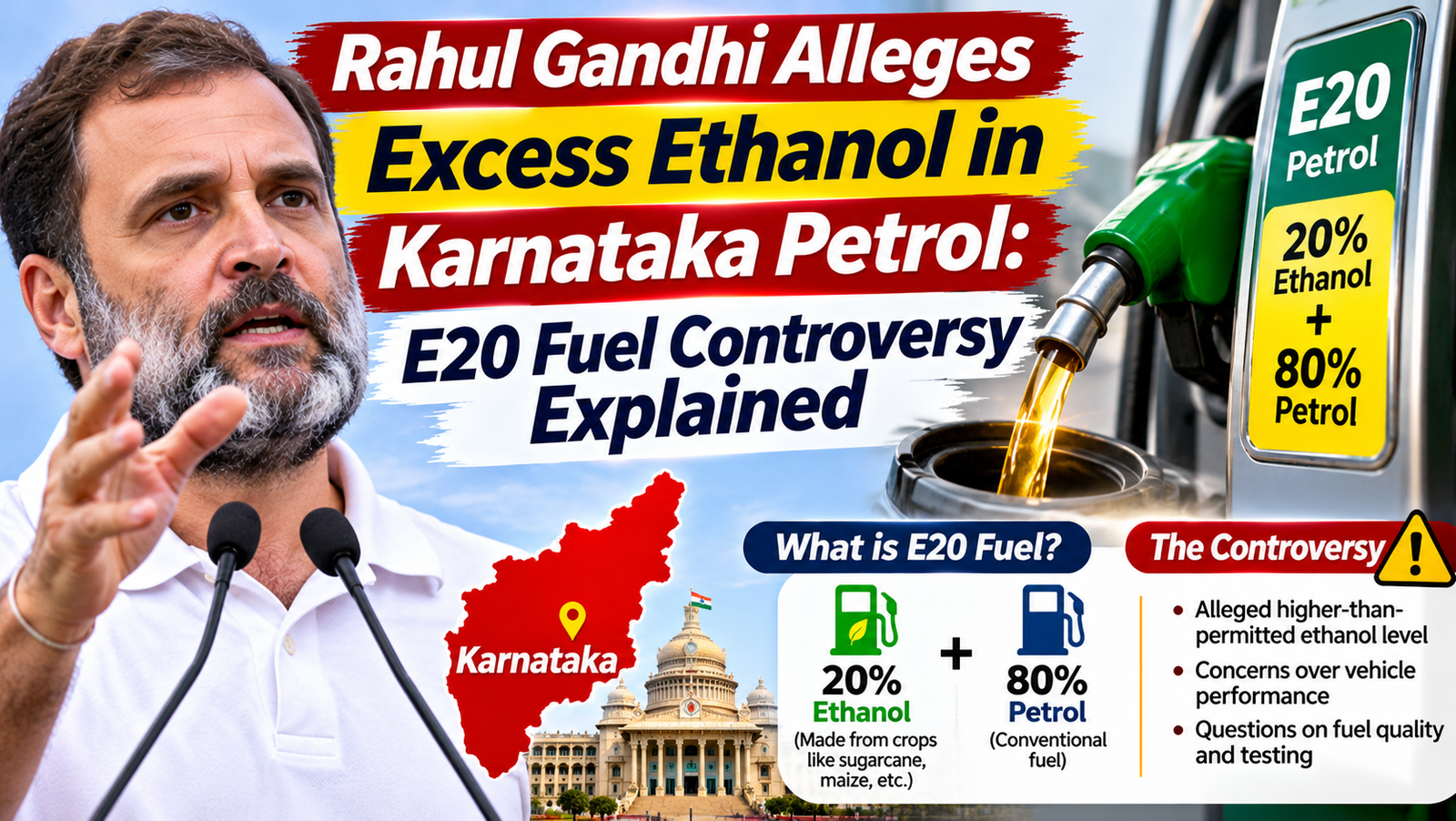
Congress leader Rahul Gandhi has raised concerns over the quality of E20 petrol in India after laboratory tests of fuel samples collected in Karnataka reportedly found ethanol levels exceeding the prescribed 20% limit. The allegations have triggered a fresh debate over petrol quality, vehicle performance, fuel standards and consumer protection.
On November 7, 2026, Rahul Gandhi questioned the central government and major oil marketing companies after citing test results from petrol samples collected across seven districts of Karnataka. He claimed that 11 out of 14 tested samples contained more than 20% ethanol, with some reportedly recording levels above 30%.
The issue has attracted attention because India’s ethanol-blending programme is intended to reduce dependence on imported crude oil and support cleaner fuel alternatives. However, questions about excess ethanol blending, vehicle compatibility and fuel transparency have become central to the latest E20 petrol controversy.
Rahul Gandhi Questions Ethanol Content in Karnataka Petrol
Rahul Gandhi, the Leader of the Opposition in the Lok Sabha, criticised the Centre over alleged excess ethanol blending in petrol.
In a post on X on November 7, Gandhi used the phrase “E20 turned into 420” to question whether consumers were receiving petrol with ethanol content above the prescribed limit.
He cited laboratory findings from Karnataka, claiming that 11 of 14 petrol samples tested at an accredited laboratory contained more than 20% ethanol.
According to the figures he shared, an Indian Oil Corporation (IOCL) sample reportedly recorded 31.2% ethanol, while a Hindustan Petroleum Corporation Limited (HPCL) sample recorded 30.5%.
Gandhi also questioned the transparency of oil companies’ testing procedures and demanded clarification from Prime Minister Narendra Modi regarding the actual ethanol content in petrol supplied to consumers.
He called for action against companies found violating fuel standards.
These figures are allegations based on the test results cited by Gandhi and Karnataka authorities. The oil companies have disputed the testing methodology and findings.
What Did Karnataka’s Petrol Sample Tests Reveal?
The controversy gained momentum after the Karnataka government announced that it had tested petrol samples collected from different districts.
According to state officials, 63 samples were collected from fuel outlets operated by several oil marketing companies. The samples came from seven districts, including Bengaluru, Kolar, Chikkaballapura, Bengaluru Rural, Ramanagara, Mangaluru and Tumakuru.
The Karnataka government said independent laboratory testing identified ethanol concentrations above the E20 benchmark in several samples.
Some of the reported readings included:
| Oil company / fuel sample | Reported ethanol content |
|---|---|
| Indian Oil Corporation | 31.2% |
| Hindustan Petroleum | 30.5% |
| Bharat Petroleum | 26.5% |
| Nayara Energy | 26.1% |
| Shell | 25.5% |
These figures were reported by Karnataka authorities and should be understood as results from the specific samples tested, not as proof that all petrol sold by these companies contains excess ethanol.
The findings have raised questions about fuel quality control, testing procedures and compliance with India’s ethanol-blending standards.
What Is E20 Petrol and Why Is It Important?
E20 petrol is a fuel blend containing approximately 20% ethanol and 80% petrol.
Ethanol is an alcohol-based fuel commonly produced from agricultural materials such as sugarcane and grains. It can be blended with petrol and used in compatible vehicles.
India has promoted ethanol blending as part of its strategy to reduce crude oil imports, support domestic agricultural producers and lower certain emissions associated with conventional petrol.
The government’s ethanol-blending programme has encouraged fuel companies to increase the share of ethanol in petrol supplied across the country.
However, maintaining the prescribed blending percentage is important. E20 fuel is designed around a specific composition, and significant deviations from that specification require proper investigation and verification.
Why Is Excess Ethanol in Petrol a Concern for Vehicle Owners?
The reported Karnataka test results have raised concerns about the possible effects of excess ethanol blending on vehicles.
Ethanol has different fuel properties from petrol. Its energy content per litre is lower, and its interaction with certain vehicle materials can differ from conventional petrol.
Potential concerns include:
1. Reduced Fuel Mileage
Ethanol contains less energy per litre than petrol. As a result, ethanol-blended fuel can deliver lower mileage than conventional petrol, depending on the vehicle and fuel composition.
If ethanol levels exceed the intended blend, the effect on fuel efficiency may become a concern.
2. Vehicle Compatibility
Not every vehicle is designed for the same ethanol concentration.
Manufacturers consider fuel compatibility when designing engines, fuel systems and related components. Using fuel outside the vehicle’s specified requirements may create operational concerns.
3. Higher Maintenance Costs
Excessive or unsuitable fuel blends could potentially affect certain fuel-system components, depending on vehicle design and material compatibility.
Motorists have therefore raised concerns about possible additional servicing and repair expenses.
4. Consumer Transparency
Consumers generally need reliable information about the fuel they purchase.
The controversy has renewed calls for clear disclosure of ethanol content at petrol pumps, along with accessible information about fuel quality and vehicle compatibility.
These are potential concerns, not proof that every vehicle using E20 petrol will experience damage.
Oil Companies Reject Karnataka’s Excess Ethanol Allegations
Major public-sector oil marketing companies have disputed the Karnataka government’s reported findings.
Indian Oil Corporation, Bharat Petroleum Corporation Limited and Hindustan Petroleum Corporation Limited issued a joint response stating that the findings were not supported by testing conducted according to prescribed statutory and technical procedures.
The companies said their own tests of 56 E20 samples collected across Karnataka showed ethanol content between 19% and 20%.
They also stated that tests of 893 samples collected from depots and retail outlets across 27 states and union territories were within the prescribed range.
The companies requested that Karnataka share its sampling records, laboratory reports and testing details. They also proposed joint testing to establish the actual ethanol content of the disputed fuel samples.
This disagreement means that the reported laboratory results and the companies’ internal testing results need to be examined through transparent and independently verifiable procedures.
What Does the E20 Petrol Controversy Mean for Indian Consumers?
The E20 petrol controversy has brought fuel quality and consumer protection into the national discussion.
Motorists depend on petrol that meets established specifications and is suitable for their vehicles. If fuel supplied at retail outlets does not meet the applicable standards, consumers could face financial and operational concerns.
The issue also raises important questions:
- Are petrol companies consistently meeting the prescribed ethanol-blending standards?
- Are fuel testing procedures transparent and independently verifiable?
- Should petrol pumps display the ethanol percentage in the fuel they sell?
- How should complaints about fuel quality be investigated?
- What protection should be available to vehicle owners if a confirmed violation causes damage?
Clear answers will be important for maintaining public confidence in India’s ethanol-blending programme.
Why Does India Promote Ethanol Blending in Petrol?
India’s ethanol-blending programme is part of a broader energy strategy.
The country imports a substantial share of its crude oil requirements. Increasing the use of domestically produced ethanol can help reduce some dependence on imported petroleum products.
The programme also aims to create additional demand for agricultural feedstocks and support domestic biofuel production.
Some of the major objectives include:
Reducing crude oil imports: Ethanol blending can replace a portion of the petrol requirement with domestically produced fuel.
Supporting farmers: Increased ethanol production can create demand for agricultural feedstocks.
Diversifying energy sources: Biofuels can contribute to a broader mix of energy sources.
Environmental objectives: Ethanol blending can help reduce certain emissions, although the overall environmental impact depends on production methods and the full fuel lifecycle.
The latest controversy does not automatically invalidate the objectives of ethanol blending. Instead, it highlights the importance of quality control, accurate testing and regulatory compliance.
What Happens Next in the E20 Petrol Controversy?
The disagreement between Karnataka authorities and oil marketing companies is likely to keep attention focused on independent fuel testing.
Karnataka has called for greater accountability and transparency, while the oil companies have challenged the testing process and proposed joint verification.
Rahul Gandhi has also demanded answers from the central government about the actual ethanol content in petrol and possible action against companies found violating the prescribed standards.
A transparent investigation could help establish whether the reported excess ethanol levels reflect genuine fuel-quality violations, testing differences or problems in the sampling process.
Until the findings are independently verified, consumers should avoid treating every reported sample result as representative of petrol sold across India.
Conclusion
The Rahul Gandhi ethanol controversy has brought fresh attention to India’s E20 petrol programme and the importance of maintaining fuel quality standards.
Laboratory results cited by Gandhi and Karnataka authorities reportedly showed ethanol levels above the prescribed 20% limit in several petrol samples. However, major oil marketing companies have disputed the findings and presented different testing results.
The central issue now is the need for transparent, independent verification and clear information for consumers. Ensuring that petrol meets established specifications will be essential for protecting motorists and maintaining confidence in India’s ethanol-blending programme.
Frequently Asked Questions
1. What is the Rahul Gandhi ethanol controversy?
Rahul Gandhi questioned the ethanol content of petrol sold in Karnataka after citing laboratory tests that allegedly found ethanol levels above the prescribed 20% E20 limit.
2. What is the highest ethanol percentage reported in Karnataka petrol samples?
Karnataka authorities reported an ethanol concentration of 31.2% in an Indian Oil sample. The finding has been disputed by oil marketing companies.
3. What does E20 petrol mean?
E20 petrol is a fuel blend containing approximately 20% ethanol and 80% petrol.
4. Which companies were mentioned in the Karnataka petrol testing controversy?
The companies mentioned included Indian Oil Corporation, Hindustan Petroleum, Bharat Petroleum, Nayara Energy and Shell.
5. Have oil companies accepted the allegations of excess ethanol blending?
No. Indian Oil, BPCL and HPCL disputed the findings, saying their own tests showed ethanol levels between 19% and 20% in 56 samples collected in Karnataka.
6. Can excess ethanol affect vehicle mileage?
Ethanol contains less energy per litre than petrol, so fuel mileage can vary with the ethanol blend and vehicle design. Fuel outside the vehicle’s approved specifications may also raise compatibility concerns.
7. Why does India promote E20 petrol?
India promotes ethanol blending to reduce crude oil import dependence, support domestic ethanol production and diversify its transport fuel supply.
8. Is every petrol sample in Karnataka above the 20% ethanol limit?
No. The reported findings concern specific samples collected and tested. They do not establish that all petrol sold in Karnataka or across India exceeds the E20 limit.
