


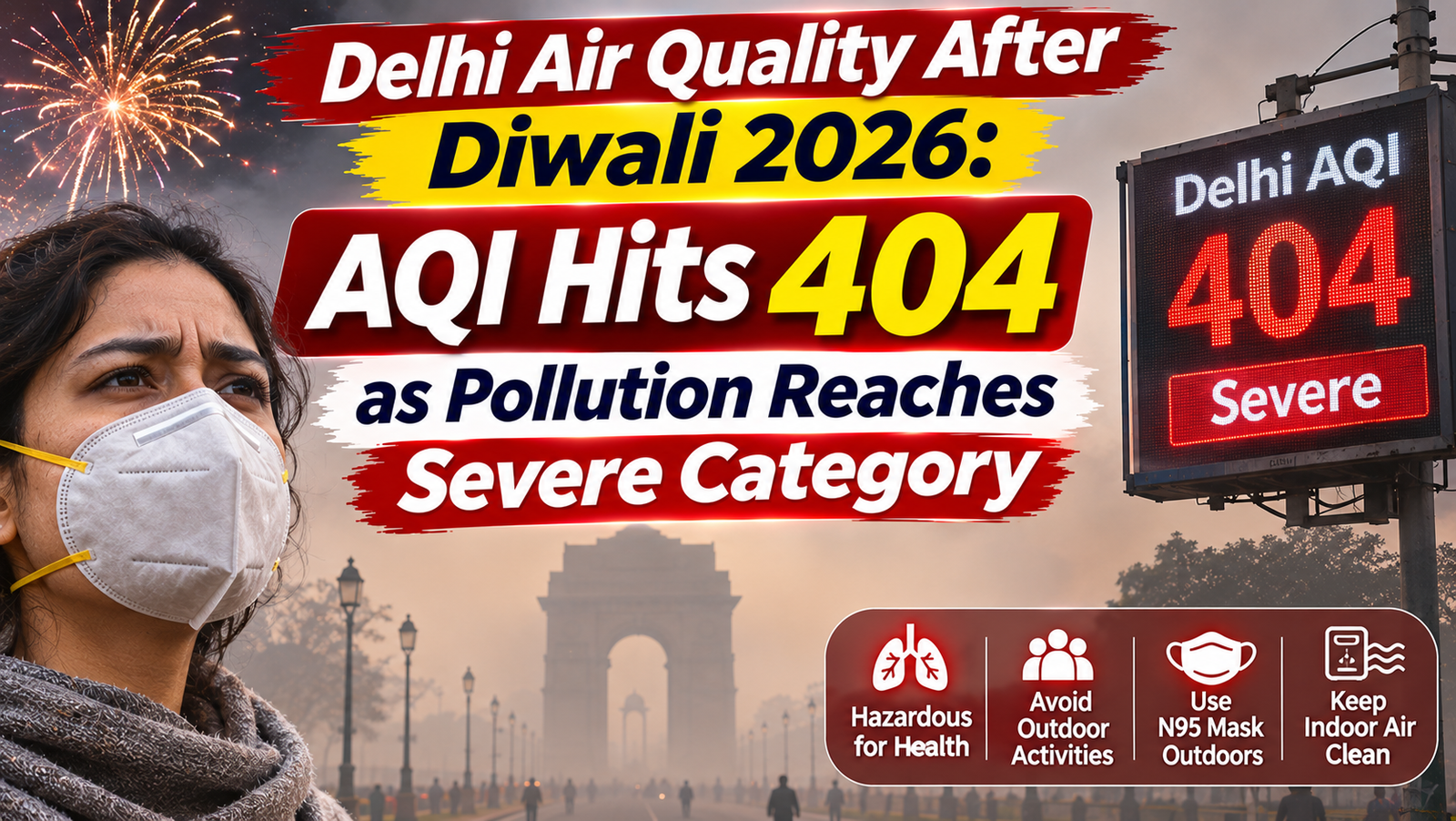
New Delhi, November 9, 2026: Delhi’s air quality after Diwali 2026 deteriorated sharply on Monday morning, with several areas of the national capital recording pollution levels in the severe category. Thick smog covered parts of Delhi-NCR, reducing visibility and raising concerns about respiratory health.
According to Central Pollution Control Board (CPCB) monitoring data cited in news reports, the Air Quality Index (AQI) reached around 404 in early post-Diwali reports. The ITO monitoring station recorded an AQI of 406 at approximately 4:20 a.m., while several other locations reported readings above 400.
The worsening Delhi air pollution situation came despite Stage III restrictions under the Graded Response Action Plan (GRAP) already being implemented across the National Capital Region.
Delhi Air Quality After Diwali 2026 Reaches Severe Levels
Delhi woke up to a blanket of smog on November 9, a day after Diwali celebrations. Several neighbourhoods experienced poor visibility as pollution accumulated overnight.
Monitoring stations across the capital recorded different AQI levels, ranging from very poor to severe.
Early morning readings included:
| Delhi location | Reported AQI | Air quality category |
|---|---|---|
| Burari Crossing | 441 | Severe |
| Vivek Vihar | 437 | Severe |
| Delhi Technological University | 434 | Severe |
| Jahangirpuri | 433 | Severe |
| Rohini | 430 | Severe |
| Ghazipur | 418 | Severe |
| Mundka | 417 | Severe |
| Punjabi Bagh | 409 | Severe |
| ITO | 406 | Severe |
| Akshardham | 337 | Very Poor |
These figures reflect reported monitoring-station readings during the morning and should not be interpreted as a single citywide AQI measurement.
Later reporting also showed that Delhi’s citywide AQI could differ from the readings at individual stations, depending on the reporting time and monitoring method.
Why Did Delhi’s AQI Increase After Diwali?
Several factors contribute to Delhi’s worsening air quality during the winter season. Firecracker emissions during Diwali can add to existing pollution, particularly when weather conditions prevent pollutants from dispersing.
1. Firecracker Emissions During Diwali
Firecrackers release particulate matter and other pollutants into the atmosphere.
When large numbers of fireworks are used within a short period, pollution concentrations can rise significantly, especially during the evening and overnight hours.
Reports indicated that fireworks were used during Diwali celebrations despite restrictions on their timing and type.
2. Weather and Low Wind Speeds
Weather conditions play an important role in Delhi’s air pollution.
During cooler months, weak winds and temperature inversions can trap pollutants near the ground, limiting their dispersal.
These conditions can cause pollution from multiple sources to accumulate.
3. Vehicle Emissions
Delhi’s large number of vehicles contributes to nitrogen oxides, particulate matter and other pollutants.
Heavy traffic and congestion can worsen air quality, particularly along major roads and busy intersections.
4. Construction and Road Dust
Construction activities, exposed soil and road dust are additional sources of particulate pollution.
When dust combines with emissions from traffic, industry and other sources, overall air quality can deteriorate.
5. Regional Agricultural Burning
Seasonal crop-residue burning in parts of northern India can contribute to regional air pollution.
However, its contribution to Delhi’s pollution varies with weather patterns, wind direction and the timing of burning activities.
No single source should be assumed to explain the entire post-Diwali AQI increase without detailed pollution-source analysis.
What Does an AQI of 404 Mean?
An AQI of 404 falls within the severe category under India’s air quality classification system.
The CPCB divides air quality into six categories:
| AQI range | Air quality category |
|---|---|
| 0–50 | Good |
| 51–100 | Satisfactory |
| 101–200 | Moderate |
| 201–300 | Poor |
| 301–400 | Very Poor |
| 401–500 | Severe |
Severe air pollution can affect healthy individuals and may cause more serious problems for people with existing respiratory or cardiovascular conditions.
The higher the AQI, the greater the potential health risk associated with outdoor exposure.
Delhi Pollution After Diwali: Health Risks for Residents
Poor air quality can affect people of all ages, particularly those who spend long periods outdoors.
Common symptoms associated with exposure to polluted air include:
- Coughing and throat irritation
- Eye irritation and watering
- Breathing discomfort
- Wheezing and chest tightness
- Increased asthma symptoms
- Reduced tolerance for outdoor physical activity
Children, older adults, pregnant people and individuals with asthma, chronic lung disease or heart conditions may be more vulnerable.
People experiencing severe breathing difficulty, chest pain or other serious symptoms should seek medical attention promptly.
GRAP Stage III Restrictions Continue in Delhi-NCR
The Commission for Air Quality Management (CAQM) had already implemented Stage III of the Graded Response Action Plan before Diwali because of concerns about worsening pollution.
GRAP is an emergency response framework designed to reduce emissions when air quality deteriorates across Delhi-NCR.
Stage III measures can include:
Construction restrictions: Suspension of specified non-essential construction and demolition activities, subject to exemptions.
Vehicle restrictions: Additional limits on certain categories of vehicles, depending on the applicable rules.
School-related measures: Hybrid learning arrangements for specified classes under the prevailing directions.
Dust control: Stronger enforcement of measures to reduce road dust and construction-related emissions.
Pollution monitoring: Increased surveillance and enforcement by relevant authorities.
Residents should consult current CAQM and local government orders for the exact restrictions in force, as implementation can change.
Delhi Air Pollution: What Residents Can Do to Stay Safe
When the Delhi AQI enters the severe category, reducing exposure to polluted outdoor air becomes important.
1. Limit Outdoor Activities
Avoid unnecessary outdoor exercise, especially during periods when pollution levels are highest.
Children and people with respiratory conditions should take additional precautions.
2. Wear a Well-Fitting N95 Mask
A properly fitted N95 or equivalent particulate respirator can help reduce exposure to airborne particles when outdoor travel is unavoidable.
Ordinary cloth masks generally provide less reliable protection against fine particulate pollution.
3. Improve Indoor Air Quality
Keep windows closed during periods of severe outdoor pollution when practical.
An appropriately sized air purifier with a HEPA filter can help reduce indoor particulate pollution.
4. Avoid Indoor Smoke
Smoking, burning incense and other indoor combustion activities can add pollutants to indoor air.
Reducing these sources can help maintain cleaner indoor conditions.
5. Monitor Official AQI Updates
Air quality changes throughout the day.
Residents can check the CPCB’s official monitoring platform and local government advisories before planning outdoor activities.
How Does Delhi’s Pollution Compare With Other Cities?
Air quality problems were also reported in other Indian cities following Diwali.
Mumbai recorded an overall AQI of around 170 on Monday morning, placing it in the moderate category, although individual locations recorded higher pollution levels.
Lucknow also experienced hazy conditions.
However, pollution levels can vary considerably between cities, neighbourhoods and monitoring stations. Comparisons should use the same AQI methodology and reporting period.
Why Does Delhi Face Severe Air Pollution Every Winter?
Delhi experiences recurring air pollution problems during the winter months because of a combination of emissions and atmospheric conditions.
Major contributors include road transport, dust, industrial activity, waste burning, regional pollution and seasonal agricultural burning.
Winter weather can make these emissions more difficult to disperse.
This means that controlling Delhi’s pollution requires sustained measures throughout the year rather than relying only on emergency restrictions during severe pollution episodes.
Long-term improvements depend on cleaner transport, better dust management, industrial emission controls, regional coordination and consistent enforcement.
What Happens Next for Delhi’s Air Quality?
The immediate outlook for Delhi’s air quality depends on weather conditions, emission levels and the effectiveness of pollution-control measures.
Authorities may continue or modify GRAP restrictions based on monitoring data and forecasts.
Residents should follow official updates because an AQI reading recorded in the morning may change significantly by afternoon or evening.
The post-Diwali pollution episode highlights the importance of both emergency responses and long-term action to improve air quality in the national capital.
Conclusion
Delhi’s air quality after Diwali 2026 deteriorated into the severe category at multiple monitoring stations, with early reports highlighting an AQI of around 404 and an ITO reading of 406.
Thick smog and reduced visibility affected several parts of Delhi-NCR despite GRAP Stage III restrictions being in force.
Firecracker emissions added to existing seasonal pollution pressures, while weather conditions and other sources contributed to the broader air quality problem.
The latest episode underlines the need for effective pollution control, accurate public information and precautions to protect residents during periods of severe air pollution.
Frequently Asked Questions
1. What was Delhi’s AQI after Diwali 2026?
Early reports on November 9, 2026, highlighted an AQI of around 404. Individual monitoring stations recorded different readings, including 406 at ITO.
2. Is an AQI of 404 dangerous?
Yes. Under India’s AQI classification, 404 falls in the severe category and indicates a substantial risk from polluted air.
3. Why did Delhi’s pollution increase after Diwali?
Firecracker emissions, existing vehicle and industrial pollution, dust and weather conditions that limit pollutant dispersal can all contribute to worsening air quality.
4. What is GRAP Stage III in Delhi?
GRAP Stage III is a set of pollution-control measures used during severe air quality conditions, including restrictions on certain construction and vehicle activities.
5. Which areas recorded severe pollution after Diwali?
Reported locations included Burari Crossing, Vivek Vihar, Jahangirpuri, Rohini, Ghazipur, Mundka, Punjabi Bagh and ITO.
6. How can people protect themselves from severe air pollution?
Reducing outdoor exposure, using a well-fitting N95 respirator when needed, improving indoor air quality and following official health advisories can help reduce risk.
7. Where can I check Delhi’s latest AQI?
Residents can consult the Central Pollution Control Board’s official air quality monitoring platform for updated readings.
