


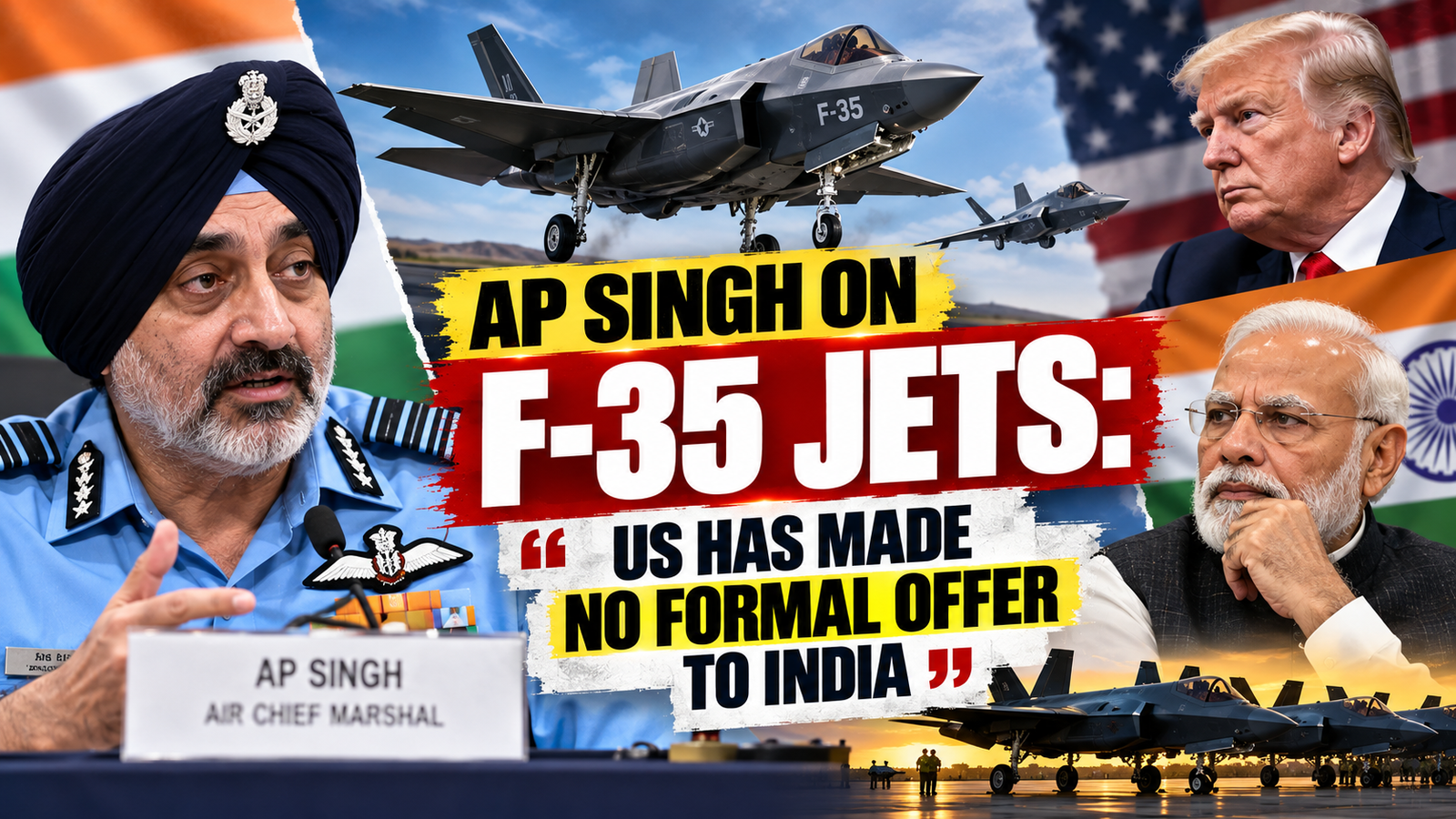
Indian Air Force Chief Air Chief Marshal AP Singh has clarified that the United States has made no formal offer to sell its F-35 stealth fighter jets to India. His remarks came during Exercise Tarang Shakti 2026 in Jodhpur, where six American F-35 Lightning II aircraft participated in a multinational air exercise for the first time on Indian soil.
Speaking alongside General Kevin Schneider, Commander of US Pacific Air Forces, Singh made a pointed remark about the limited access Indian officials received to the advanced aircraft. He said that US personnel did not even allow Indian representatives to approach the jets, despite discussions about a possible sale.
The comments have renewed attention on India’s search for fifth-generation fighter aircraft, the future of defence cooperation with the United States, and Russia’s competing offer of the Su-57 stealth fighter.
AP Singh’s Remark on US F-35 Fighter Jets
During a press conference at the conclusion of Exercise Tarang Shakti 2026, Air Chief Marshal AP Singh was asked whether the United States had formally offered the F-35 to India.
Responding with a light-hearted remark, Singh said that American personnel did not allow Indian officials to go near the aircraft, even as discussions about selling the jet had circulated.
He also clarified that Indian officials were not shown the F-35 cockpit, although Indian aircraft were allowed to fly in close formation with the American jets.
The exchange highlighted the strict security arrangements surrounding the F-35, one of the most technologically advanced fighter aircraft operated by the US military.
However, Singh’s comments also made an important point clear: the United States has not made a formal offer to sell F-35 fighter jets to India, according to the Indian Air Force chief.
What Did the US Commander Say About F-35 Security?
General Kevin Schneider, who was seated alongside Singh, explained that decisions about sharing sensitive F-35 information are governed by programme-level security rules.
He said that these guidelines determine what information can be shared, when it can be disclosed and how sensitive technology must be protected.
Such restrictions are common in advanced military programmes, where aircraft design, sensors, electronic warfare systems and other technologies are considered strategically sensitive.
The F-35 programme involves international partners and carefully controlled arrangements for technology access. As a result, participation in a joint exercise does not automatically provide foreign military personnel with unrestricted access to the aircraft.
The exchange between Singh and Schneider illustrated the difference between military cooperation and access to classified defence technology.
What Is Exercise Tarang Shakti 2026?
Exercise Tarang Shakti 2026 is a multinational air exercise hosted by the Indian Air Force at Jodhpur, Rajasthan.
The exercise brought together participating air forces to improve operational coordination, exchange professional knowledge and practise working together in complex flying scenarios.
The United States participated alongside countries including Australia, France, Germany, the United Arab Emirates, Sri Lanka and Bangladesh.
Six US Air Force F-35 Lightning II aircraft took part in the exercise, marking their first participation in an air exercise on Indian soil.
The event provided an opportunity for Indian and foreign aircrews to operate alongside one another and exchange experience. It also highlighted the growing importance of cooperation among air forces as military technology and regional security requirements evolve.
Why Is the F-35 Fighter Jet So Important?
The Lockheed Martin F-35 Lightning II is a fifth-generation multirole stealth fighter designed for air combat, precision strikes, intelligence gathering and other missions.
Its key features include:
- Stealth technology: Its design and specialised materials help reduce its radar signature.
- Advanced sensors: The aircraft combines information from different sensors to improve situational awareness.
- Electronic warfare capabilities: Its systems help detect, analyse and respond to electronic threats.
- Network connectivity: The F-35 can share information with other aircraft and compatible military systems.
- Multirole operations: Different versions are designed for a range of air force, naval and short take-off missions.
These capabilities make the F-35 an important part of the US military’s modern airpower strategy.
However, acquiring such an aircraft involves much more than purchasing the jet itself. Buyers must also consider training, weapons, maintenance, software access, upgrades and long-term operating costs.
Has the United States Offered F-35 Jets to India?
According to AP Singh’s statement on October 10, 2026, the United States has not made a formal offer to sell F-35 fighter jets to India.
Although the possibility of India acquiring the aircraft has featured in discussions about defence cooperation, a formal proposal and a completed procurement decision are different matters.
A potential purchase would require detailed negotiations about pricing, delivery schedules, technology access, operational requirements and support arrangements.
India would also need to assess how the aircraft fits into its existing fleet, which includes Russian-origin platforms, French Rafale fighters and domestically developed aircraft.
For now, the Indian Air Force chief’s comments indicate that an F-35 purchase should not be treated as a confirmed deal.
Russia’s Su-57 Offer to India
Alongside the discussion about the American F-35, AP Singh confirmed that Russia had offered its fifth-generation Su-57 fighter aircraft to India.
However, he made it clear that no decision had been taken on the Russian proposal.
The Su-57 is designed for air superiority and strike missions. Russia has presented it as an option for countries seeking advanced fighter capabilities.
India’s evaluation of any fifth-generation aircraft would involve several considerations, including performance, operational compatibility, maintenance, weapons integration and access to relevant technology.
The Russian proposal therefore represents a possible option rather than a confirmed Indian procurement plan.
Why Does India Need a Fifth-Generation Fighter?
India is working to strengthen its air combat capabilities as neighbouring countries expand their use of advanced military aircraft.
China operates the J-20 stealth fighter and is developing additional combat aviation capabilities. Pakistan has also been linked to plans to acquire China’s J-35 aircraft, although reported procurement plans and actual deliveries are not the same.
These developments have increased attention on India’s options for acquiring or developing fifth-generation fighters.
The Indian Air Force must consider how to maintain its operational capabilities while planning for future threats. Advanced aircraft could provide benefits in stealth, sensor integration, electronic warfare and information sharing.
At the same time, purchasing foreign aircraft can create long-term dependence on overseas suppliers for maintenance, spare parts, software and upgrades.
India must therefore balance near-term operational requirements with its long-term objective of developing domestic defence technology.
India’s Indigenous AMCA Fighter Project
India is developing the Advanced Medium Combat Aircraft (AMCA), an indigenous fifth-generation fighter programme intended to strengthen the country’s domestic combat aircraft capabilities.
The project is important because it aims to reduce long-term dependence on foreign fighter technology while building national expertise in advanced aircraft design and manufacturing.
However, developing a fifth-generation fighter involves complex engineering, testing, certification and production challenges. It takes considerable time to move from development to operational service.
The AMCA programme is therefore part of India’s long-term defence planning rather than an immediately available replacement for existing aircraft.
In the meantime, the Indian Air Force must assess how to address its operational requirements while the indigenous programme progresses.
What Could the F-35 and Su-57 Offers Mean for India’s Defence Strategy?
The discussion surrounding the F-35 and Su-57 highlights the range of choices India faces in modernising its air force.
An American aircraft could offer access to advanced sensors and a highly integrated combat system, subject to the terms of any potential agreement. A Russian aircraft would bring a different set of technical characteristics, support arrangements and strategic considerations.
The choice would not depend on aircraft performance alone. India would also need to assess acquisition costs, maintenance requirements, weapons compatibility, technology transfer and the degree of operational independence available.
Another important consideration is how any imported aircraft would complement India’s existing fleet and its domestic AMCA programme.
For now, the United States has made no formal F-35 sales offer, while India has not decided whether to pursue Russia’s Su-57 proposal. Any future decision will depend on the government’s assessment of its defence requirements and available options.
Conclusion
Air Chief Marshal AP Singh’s remarks during Exercise Tarang Shakti 2026 have brought renewed attention to India’s fifth-generation fighter plans and its defence relationship with the United States.
His comments made clear that the US has not formally offered the F-35 to India, while the aircraft’s restricted access arrangements highlighted the security controls surrounding advanced military technology.
Russia has offered India its Su-57 fighter, but no decision has been announced on that proposal either. Meanwhile, India’s indigenous AMCA programme remains a key part of its long-term aviation strategy.
The main question is how India will meet its future air combat requirements while balancing advanced foreign technology, operational independence and domestic defence development.
Frequently Asked Questions (FAQs)
1. What did AP Singh say about US F-35 fighter jets?
Air Chief Marshal AP Singh said that American personnel did not allow Indian officials to approach the F-35 aircraft and clarified that the United States had made no formal offer to sell them to India.
2. Did the US formally offer F-35 jets to India?
No. AP Singh stated on October 10, 2026, that the United States had not made a formal offer to sell F-35 fighter jets to India.
3. What is Exercise Tarang Shakti 2026?
Tarang Shakti 2026 is a multinational air exercise hosted by the Indian Air Force. It brought together participating countries to practise flying operations and improve coordination.
4. How many US F-35 jets participated in Tarang Shakti 2026?
Six US F-35 Lightning II fighter jets participated in the exercise, marking their first appearance in an air exercise on Indian soil.
5. Has Russia offered its Su-57 fighter to India?
Yes. AP Singh confirmed that Russia had offered the Su-57, but he said that no decision had been made on the proposal.
6. What is India’s AMCA fighter project?
The Advanced Medium Combat Aircraft is India’s indigenous fifth-generation fighter programme, designed to strengthen domestic combat aircraft development.
7. Why is India considering fifth-generation fighter aircraft?
India is assessing future air combat requirements as China expands its stealth aircraft capabilities and regional military aviation continues to evolve.
