


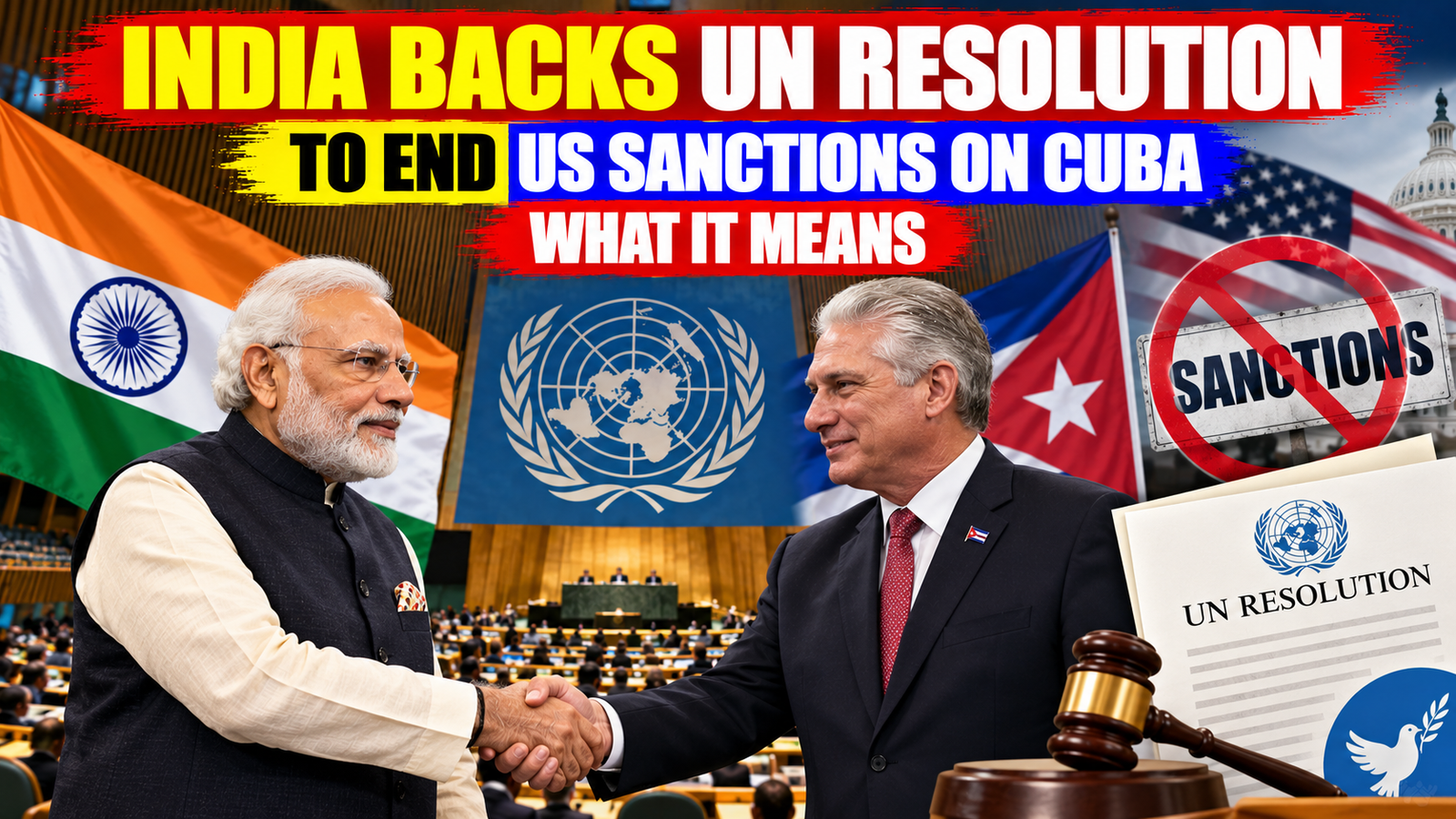
India has voted in favour of a United Nations General Assembly resolution calling for an end to the long-standing US economic, commercial and financial embargo on Cuba. The India backs UN resolution to end US sanctions on Cuba development highlights New Delhi’s continued support for multilateral diplomacy, national sovereignty and international cooperation.
The resolution was adopted on October 28, 2026, with 130 countries voting in favour, 17 opposing it and 25 abstaining. India’s position was presented by Soumya Nair, Counsellor at India’s Permanent Mission to the United Nations.
India said the restrictions have affected Cuba’s economy, healthcare, food production and access to essential services. It also called on countries to avoid applying laws with effects beyond their national borders when those laws undermine the sovereignty of other states.
Why Did India Support the UN Resolution on Cuba?
India supported the resolution because it wants the longstanding US embargo on Cuba to be lifted. New Delhi reiterated its position that international disputes should be addressed through dialogue, diplomacy and cooperation under the United Nations Charter.
Speaking before the General Assembly vote, Soumya Nair said India supports the Assembly’s repeated calls for an end to the restrictions.
India also highlighted the wider principle of national sovereignty. Its statement opposed laws and regulations with extraterritorial effects that adversely affect other countries and their development.
New Delhi said lifting the embargo would help Cuba participate more fully in international cooperation and pursue its development goals.
What Was the Result of the UN General Assembly Vote?
The 193-member United Nations General Assembly adopted the resolution on October 28, 2026.
The voting result was:
- In favour: 130 countries
- Against: 17 countries
- Abstained: 25 countries
The resolution called for an end to the US economic, commercial and financial embargo against Cuba.
Although a large majority supported the measure, the number of countries voting in favour was lower than in the previous year’s vote. In 2025, the resolution received 165 votes in favour, seven against and 12 abstentions.
The 2026 result reflects changing diplomatic positions and increased efforts by Washington to persuade countries to reconsider their support for the annual resolution.
How Have US Sanctions Affected Cuba’s Economy?
Cuba has faced a prolonged economic crisis involving shortages of fuel, food, medicines and other essential goods. The US embargo has been a major point of disagreement between Washington and Havana for decades.
During India’s statement at the UN, Soumya Nair referred to a report by the UN Secretary-General and highlighted the reported impact of restrictions on essential services.
According to the figures cited by India:
- Cuba’s healthcare system faced shortages of more than 60% of essential medicines.
- Food production declined by over 50% during the previous five years.
- Restrictions affecting fuel supplies contributed to the country’s energy difficulties.
- Shortages disrupted healthcare, education, water supplies, food distribution and transportation.
India argued that lifting the restrictions could help create better conditions for Cuba’s economic and social development.
However, Cuba’s economic difficulties have several contributing factors. The effects of US restrictions, domestic economic conditions and infrastructure challenges are part of the wider debate over the country’s crisis.
What Is the US Embargo Against Cuba?
The US embargo against Cuba is a system of economic, commercial and financial restrictions that dates back to the Cold War period.
Washington introduced restrictions after the Cuban Revolution and the deterioration of relations between the two countries. Over the decades, successive US administrations have maintained or adjusted different parts of the sanctions framework.
The restrictions affect trade, financial transactions, investment and other economic activities involving Cuba.
The US government has defended its policy by pointing to concerns about Cuba’s political system and human rights record. Cuba, meanwhile, argues that the embargo restricts its economic development and harms ordinary citizens.
The disagreement has remained a major issue in international diplomacy for more than six decades.
Can the UN Resolution Force the United States to Lift Sanctions?
No. The UN General Assembly resolution is non-binding and does not automatically remove US sanctions.
It carries political and diplomatic significance because it records the position of member states on the issue. However, the resolution does not have the legal power to directly change US domestic sanctions laws.
The US Congress has a central role in changing or removing the legal framework behind the embargo. Therefore, even after the latest UN vote, the restrictions remain in place unless the United States takes the necessary legal and policy steps.
The annual vote is still important because it gives countries an opportunity to express their views on the embargo and its international consequences.
Why Is India’s Position Important in International Diplomacy?
India’s support for the resolution reflects its stated commitment to multilateralism and diplomatic engagement.
New Delhi has repeatedly emphasised the importance of respecting national sovereignty and resolving international disputes through dialogue. Its statement at the General Assembly also raised concerns about laws that have effects beyond the borders of the countries that introduce them.
India’s position is significant because it supports the UN’s call for an end to the embargo while maintaining a broader argument about international law and the sovereignty of states.
The vote also demonstrates India’s willingness to express its position on longstanding international issues through multilateral institutions.
Why Did Some Countries Oppose or Abstain From the Resolution?
Not every country supported the resolution. In the 2026 vote, 17 countries voted against it and 25 abstained.
The United States and Israel were among the countries opposing the measure. Several countries that had previously supported the resolution chose to abstain this year.
Reuters reported that US diplomatic efforts influenced the voting pattern, with some Western countries changing their positions.
The US government has argued that the resolution does not adequately address concerns about Cuba’s political leadership and governance. Supporters of the resolution, on the other hand, focus on the economic and humanitarian consequences of the embargo.
The different voting positions demonstrate that international opinion on the issue is not completely uniform.
What Happens Next After India’s Vote at the UN?
The immediate result of the vote is diplomatic rather than a direct change in US policy. The embargo remains in place, and the UN resolution does not automatically alter trade or financial restrictions.
India is expected to continue supporting dialogue and multilateral engagement on international issues. Cuba will also continue seeking international support for its demand to end the embargo.
The future of US-Cuba relations will depend on decisions taken by Washington and Havana, including any changes in sanctions policy and diplomatic engagement.
For now, the General Assembly vote has once again placed the decades-old embargo at the centre of international discussion.
Conclusion
India’s support for the UN resolution to end US sanctions on Cuba highlights New Delhi’s position on multilateral diplomacy, national sovereignty and international cooperation.
The resolution received 130 votes in favour, 17 against and 25 abstentions. India also highlighted the reported impact of restrictions on Cuba’s medicines, food production, energy supplies and essential services.
However, the vote does not automatically lift the US embargo. It remains a non-binding resolution, and any major change in the sanctions framework will require action by the United States.
The development keeps the long-running US-Cuba dispute in focus and underlines the continuing differences among countries over how the issue should be resolved.
Frequently Asked Questions (FAQs)
1. Did India support the UN resolution to end US sanctions on Cuba?
Yes. India voted in favour of the UN General Assembly resolution calling for an end to the US economic, commercial and financial embargo on Cuba.
2. When did the UN vote on the Cuba embargo?
The United Nations General Assembly voted on the resolution on October 28, 2026.
3. How many countries supported the UN resolution?
A total of 130 countries voted in favour, 17 voted against and 25 abstained.
4. Who represented India during the UN discussion?
Soumya Nair, Counsellor at India’s Permanent Mission to the United Nations, delivered India’s statement.
5. Why does India want the US embargo on Cuba lifted?
India said the restrictions affect Cuba’s development and access to essential services. It also reiterated its support for sovereignty, multilateralism and diplomatic solutions.
6. Will the UN resolution immediately end US sanctions on Cuba?
No. The resolution is non-binding and does not automatically change US sanctions. Changes to the embargo require action by the United States.
7. How long have US restrictions on Cuba existed?
The US embargo dates back to the early 1960s and has remained a major issue in relations between the two countries.
8. Why did some countries abstain from the 2026 vote?
Countries have different diplomatic positions on the embargo. Reuters reported that US efforts to influence the vote contributed to changes in some countries’ voting decisions.
