


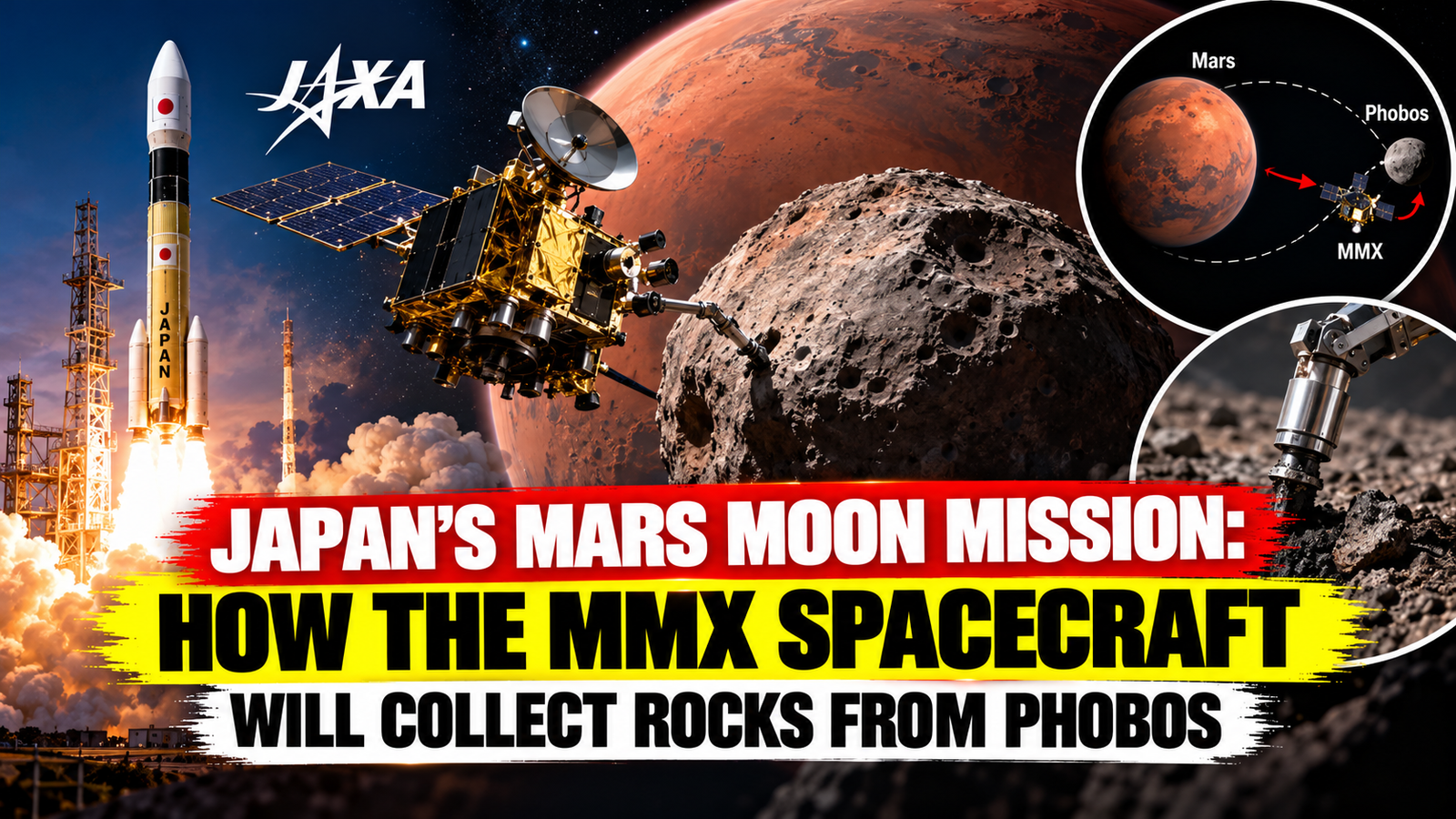
Japan has launched an ambitious space mission to explore Phobos, one of Mars’s two moons, and bring samples back to Earth. The mission, known as Martian Moons eXploration (MMX), could help scientists answer important questions about how Mars’s moons formed and how material moved through the early solar system.
Led by the Japan Aerospace Exploration Agency (JAXA), the mission launched aboard Japan’s H3 rocket from Tanegashima Space Center on October 20, 2026, local time. If the mission proceeds as planned, the spacecraft will collect rock and soil from Phobos and return the samples to Earth in 2031.
The project represents a major step in planetary exploration because no mission has previously attempted to return samples from either of Mars’s moons.
What Is Japan’s Mars Moon Mission?
Japan’s MMX mission is designed to investigate the origins of Phobos and Deimos, the two small moons orbiting Mars. Scientists have several theories about how these moons formed, but they still lack enough direct evidence to settle the question.
The spacecraft will travel to the Martian system, study Phobos, deploy a small rover and attempt to collect surface material. It will also observe Deimos before beginning its journey back to Earth.
According to reports from the Associated Press, the mission is expected to return at least 10 grams of material if its sampling operation succeeds.
The samples will allow researchers to conduct detailed laboratory tests that would be difficult or impossible to perform using instruments aboard a spacecraft.
Why Is Phobos Important to Scientists?
Phobos is the larger and closer of Mars’s two moons. It is an irregular, potato-shaped object measuring approximately 22 kilometres across and orbits Mars at a relatively short distance.
Despite its small size, Phobos could contain valuable clues about the history of the Martian system.
Scientists are investigating two leading explanations for the moon’s origin. One possibility is that Phobos formed from debris created by a major impact on Mars. Another theory suggests that it is an asteroid captured by the planet’s gravity.
Studying actual samples could help researchers determine which explanation better matches the moon’s composition.
The material may also contain particles ejected from Mars by ancient impacts. If confirmed, these particles could offer additional information about the Red Planet’s geological history.
How Will the MMX Spacecraft Collect Rocks From Phobos?
The MMX mission involves several carefully planned stages. Each stage must work correctly for the spacecraft to deliver its samples to Earth.
1. Travelling to Mars
After its successful launch, the MMX spacecraft began its journey towards Mars. It is expected to reach the Martian system in 2027, where it will begin detailed observations and prepare for its work around Phobos.
2. Deploying the Idefix Rover
The mission includes a small French-German rover called Idefix. Its role is to explore Phobos’s surface and help mission teams understand the terrain.
The rover will examine the ground and help engineers identify suitable areas for the main spacecraft’s sampling operation. This step is important because Phobos has extremely weak gravity, making landing and movement challenging.
3. Landing and Collecting Samples
After surveying the surface, the spacecraft is expected to attempt a landing on Phobos during the planned sampling phase in 2028 or 2029.
The lander aims to collect at least 10 grams of rock and soil. The operation must be carefully controlled because the moon’s low gravity makes it difficult to maintain stable contact with the surface.
4. Returning Samples to Earth
Once sampling and observations are complete, the spacecraft will begin its return journey. The sample-return capsule is expected to reach Earth in 2031, with recovery planned in Australia.
Scientists will then examine the material using advanced laboratory equipment to investigate its chemical composition, minerals and possible origins.
These stages remain planned mission objectives; the sample collection and return have not yet occurred.
What Could Scientists Discover From Phobos Samples?
The biggest scientific benefit of the MMX mission will come from studying material collected directly from the moon.
Understanding the origin of Mars’s moons: Researchers can compare the samples with known asteroid material and Martian rocks to test competing theories about how Phobos formed.
Learning about Mars’s ancient history: If the samples contain material thrown from Mars by impacts, they could reveal information about the planet’s earlier surface conditions.
Investigating the building blocks of planets: The chemical and mineral composition may provide clues about the materials present when planets and moons formed billions of years ago.
Improving knowledge of water and organic matter: Researchers hope the mission will contribute to a better understanding of how water-related materials and organic compounds were distributed in the early solar system. However, the mission is not a confirmed search for extraterrestrial life.
Preparing for future Mars exploration: Information about Phobos’s surface, terrain and composition could help scientists evaluate the moon’s potential role in future robotic or crewed exploration of Mars.
Why Is Landing on Phobos So Difficult?
Phobos presents engineering challenges that are very different from those encountered during missions to larger planetary bodies.
Its gravity is extremely weak. A lander must make controlled contact with the surface without bouncing away or becoming unstable. Loose soil, rocks and uneven terrain can also create difficulties for robotic equipment.
The Idefix rover is intended to help mission controllers assess these conditions before the main sampling operation. Its observations will help engineers choose a suitable landing and sampling location.
The spacecraft must also complete a long journey, operate reliably far from Earth and preserve the collected samples during the return trip.
These challenges make the MMX mission a significant test of Japan’s planetary exploration capabilities.
How Does Japan’s MMX Mission Compare With Other Space Missions?
Space agencies have successfully sent orbiters, landers and rovers to Mars. However, collecting material from Mars’s moons and bringing it back to Earth introduces a different set of technical challenges.
Japan also has experience with asteroid sample-return missions, including Hayabusa and Hayabusa2. Those projects demonstrated the country’s ability to collect material from small celestial bodies and deliver samples to Earth.
The MMX mission builds on that experience while targeting the Martian system.
Other countries are also developing ambitious Mars exploration plans. The scientific results from MMX could complement future missions by providing researchers with physical samples from a part of the solar system that remains poorly understood.
When Will the Mars Moon Samples Reach Earth?
The current plan is for the MMX spacecraft to return its samples to Earth in 2031.
Before then, the mission must reach Mars, study Phobos, deploy its rover, carry out the sampling operation and complete the return journey.
The timeline depends on the spacecraft and its instruments performing as expected. The 2031 date is therefore a planned return target, not a guarantee that the samples will arrive on schedule.
If successful, the mission will provide scientists with rare material from a Martian moon for detailed study.
Conclusion
Japan’s MMX mission is an important milestone in space exploration. By targeting Phobos and attempting to return rock and soil samples to Earth, the mission aims to answer long-standing questions about the origins of Mars’s moons and the evolution of the early solar system.
Its success will depend on several complex operations, from navigating the Martian system to landing in extremely weak gravity and delivering the samples safely to Earth.
If the mission achieves its objectives, the material collected from Phobos could significantly improve our understanding of Mars and help guide future planetary exploration.
Frequently Asked Questions (FAQs)
1. What is Japan’s MMX mission?
The Martian Moons eXploration mission is a JAXA-led project designed to study Phobos and Deimos, collect samples from Phobos and return them to Earth.
2. What is Phobos?
Phobos is the larger and closer of Mars’s two moons. It is an irregular, rocky object approximately 22 kilometres across.
3. When did Japan launch the Mars moon mission?
The MMX spacecraft launched aboard Japan’s H3 rocket on October 20, 2026, local time.
4. How much material will the MMX mission collect?
The mission aims to collect at least 10 grams of rock and soil from Phobos.
5. When will the samples return to Earth?
The spacecraft is scheduled to return the samples to Earth in 2031, subject to the mission proceeding as planned.
6. Why is Japan collecting samples from Phobos?
Scientists hope to determine how Mars’s moons formed and learn more about the early solar system and the geological history of Mars.
7. Has any spacecraft collected samples from Phobos before?
No successful sample-return mission from Phobos has been completed. MMX aims to achieve this for the first time.
8. Could the MMX mission help future human missions to Mars?
Yes. Its findings about the Martian system and Phobos could inform future exploration strategies, although it is not itself a crewed mission.
