


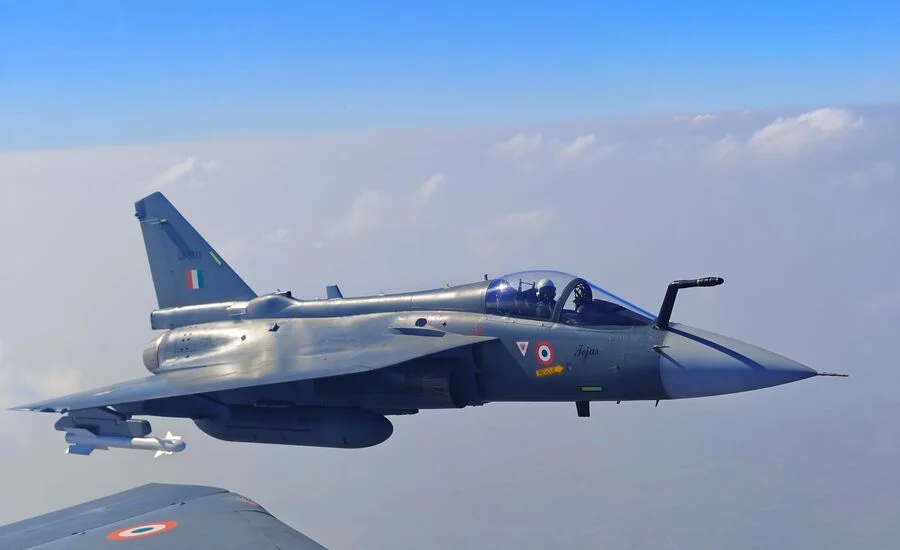
India’s indigenous fighter aircraft programme has reached another important stage with Hindustan Aeronautics Limited (HAL) completing the structural assembly of the first LCA Tejas Mk2 prototype.
The front, centre and rear sections of the aircraft’s fuselage have now been joined, bringing the first prototype closer to the ground-testing phase. HAL Chairman and Managing Director Ravi Kumar has indicated that the company is targeting the aircraft’s first ground run by March 2027, followed by its maiden flight later in 2027.
The development is significant because Tejas Mk2 is being developed as a larger and more capable fighter than the existing Tejas Mk1 and Mk1A variants.
What Is the Latest Tejas Mk2 Update?
The latest development concerns the physical integration of the first prototype.
HAL has completed the coupling of the three major fuselage sections. This means the aircraft has moved beyond the stage of producing individual major structural sections and is now progressing toward aircraft-level integration and testing.
The company is targeting a March 2027 ground run.
A ground run allows engineers to check various aircraft systems and engine-related parameters while the aircraft remains on the ground. These checks are an important step before flight testing begins.
HAL expects the first flight to take place later in 2027, subject to completion of integration, ground testing and required clearances.
What Is Tejas Mk2?
The LCA Tejas Mk2, also known as the Medium Weight Fighter, is being developed as a more advanced fighter compared with the current Tejas Mk1A.
The aircraft has a substantially redesigned and enlarged airframe. It is intended to provide greater payload and performance while incorporating newer avionics and systems.
One of the most important changes is its engine.
Tejas Mk2 is planned to use the GE Aerospace F414 afterburning turbofan, which belongs to a higher-thrust class than the GE F404 engine used by the Tejas Mk1 family.
Why the March 2027 Ground Run Matters
The ground run will be an important milestone because it represents the transition from aircraft construction to active testing.
Before a prototype can safely fly, engineers need to verify multiple systems and ensure that the aircraft is ready for the next stage.
The process can include checks related to:
- Engine operation
- Aircraft systems
- Avionics
- Flight-control systems
- Electrical and hydraulic systems
- Structural performance
- Ground handling
The exact sequence and timing of testing can change depending on the results of each stage.
Therefore, the March 2027 ground-run target should be viewed as a planned programme milestone, while the maiden flight will depend on successful completion of testing and clearances.
Tejas Mk2 Will Use the GE F414 Engine
The GE F414 is one of the major components of the Tejas Mk2 programme.
HAL is also negotiating with GE Aerospace for production of the F414 engine in India. According to the latest HAL-related update, technical issues concerning the proposed domestic production have been resolved, while commercial discussions remain part of the process.
The availability of engines will be important not only for prototype testing but also for future production of the fighter.
The Aeronautical Development Agency has already acquired a limited number of F414 engines for the prototype programme, according to HAL’s CMD.
How Is Tejas Mk2 Different From Tejas Mk1A?
Tejas Mk2 is not simply a minor upgrade to the Mk1A.
It features a substantially redesigned airframe and a more powerful propulsion system. The aircraft is being developed as a larger medium-weight fighter.
The F414 engine is expected to provide significantly more thrust than the F404 used by the existing Tejas family.
This difference is intended to support the Mk2’s larger airframe, higher performance requirements and greater operational capability.
What Happens After the Ground Run?
If the March 2027 ground-run target is achieved, the next major milestone will be the aircraft’s flight testing programme.
The prototype will need to undergo extensive checks before and during flight testing.
The first flight itself will not mark the completion of the development programme. Instead, it will begin another major phase in which engineers and test pilots evaluate the aircraft’s handling, systems and performance.
Additional prototypes are expected to support the broader testing programme.
HAL has previously indicated a multi-prototype approach, with early prototypes focused on flight safety, aerodynamics and system integration and later aircraft supporting more advanced testing.
Why Tejas Mk2 Is Important for India
Tejas Mk2 is part of India’s broader effort to develop and manufacture advanced combat aircraft domestically.
The programme involves HAL and the Aeronautical Development Agency (ADA) and is expected to contribute to India’s future fighter fleet.
The aircraft is also being developed during a period when the Indian Air Force is working to modernise its fighter inventory.
In this context, the successful development of Tejas Mk2 could become an important part of India’s long-term indigenous aerospace strategy.
Engine Manufacturing Could Be Another Major Milestone
Apart from the aircraft itself, domestic production of the F414 engine could become another important development.
HAL and GE Aerospace are working toward a framework for manufacturing the engine in India. The commercial details still need to be worked through.
If the proposed manufacturing arrangement progresses, it could create a larger domestic industrial ecosystem around the Tejas Mk2 programme.
This could involve Indian companies becoming part of the supply chain for components, manufacturing and long-term maintenance.
Tejas Mk2 Timeline: What to Expect
Based on the latest updates, the broad roadmap currently looks like this:
| Milestone | Current Target/Status |
|---|---|
| First prototype airframe | Structural assembly completed |
| Fuselage coupling | Completed |
| Ground run | Targeted for March 2027 |
| Maiden flight | Expected later in 2027 |
| Flight testing | To follow successful maiden flight |
| F414 engine production in India | Commercial discussions ongoing |
These are programme targets and can change as testing and development progress.
What Does This Mean for India’s Fighter Programme?
The completion of the first Tejas Mk2 airframe is an important physical milestone for the programme.
The aircraft has now moved closer to actual ground testing and eventually flight testing. However, several stages remain before the fighter can enter operational service.
The programme will need to progress through testing, certification, production planning and other required processes.
For now, the next major date to watch is March 2027, when HAL is targeting the first ground run.
If that milestone is achieved, attention will then shift toward the aircraft’s first flight later in 2027.
Frequently Asked Questions
What is the latest Tejas Mk2 update?
HAL has completed the structural assembly and coupling of the first Tejas Mk2 prototype airframe.
When will Tejas Mk2 conduct its first ground run?
HAL is targeting the first ground run for March 2027.
When will Tejas Mk2 fly for the first time?
The maiden flight is currently expected later in 2027, subject to successful ground testing and required clearances.
Which engine will power Tejas Mk2?
Tejas Mk2 is planned to use the GE Aerospace F414 afterburning turbofan engine.
Who is developing Tejas Mk2?
The programme involves HAL and the Aeronautical Development Agency (ADA).
Is Tejas Mk2 already operational?
No. Tejas Mk2 is still in the prototype and development stage. Its ground and flight testing still have to be completed before operational induction.
Conclusion
The completion of the first Tejas Mk2 airframe marks a new phase in India’s indigenous fighter aircraft programme.
With the fuselage sections now coupled, HAL is preparing for the next major milestone: the planned March 2027 ground run. The first flight is expected later in 2027, although the exact timing will depend on testing and clearances.
The F414 engine programme is another key part of the project, with HAL and GE Aerospace continuing work toward potential engine production in India.
For India’s aerospace industry, the coming months will therefore be closely watched as Tejas Mk2 moves from airframe assembly toward ground testing and, eventually, flight testing.
