


The world’s busiest container ports play a major role in how products reach businesses and consumers. From smartphones and clothing to furniture and industrial equipment, millions of shipping containers move through these ports every year. However, not every port handles the same volume, and the differences reveal a lot about global trade.
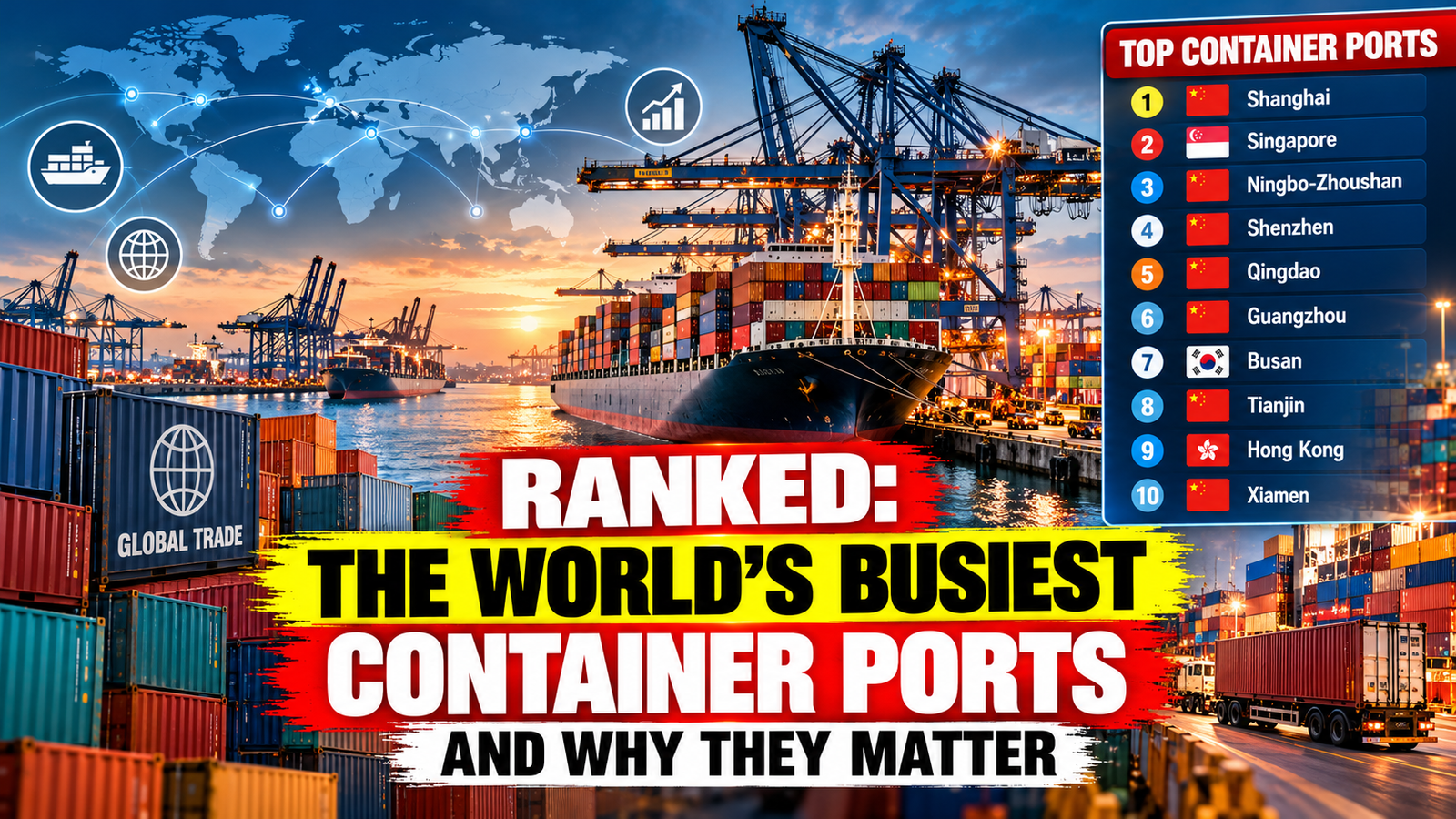
According to the latest ranking from Visual Capitalist, based on 2025 container traffic, Shanghai remains the world’s busiest container port. Singapore ranks second, while China’s Ningbo-Zhoushan port takes third place. The rankings show how strongly Asian ports influence international supply chains.
In this article, you’ll discover the world’s busiest container ports, why China dominates the rankings, how Singapore connects global shipping routes, and what these ports mean for the products you buy.
What Are the World’s Busiest Container Ports?
Container ports are ranked by the volume of containers they handle during a year. The standard measurement is the twenty-foot equivalent unit, or TEU. One standard 20-foot shipping container counts as one TEU, while a 40-foot container counts as two.
Using this measurement, Shanghai ranked first worldwide in 2025, handling approximately 55.1 million TEUs. Singapore followed with 44.66 million TEUs, and Ningbo-Zhoushan ranked third with 43.87 million TEUs.
The following table lists the world’s 30 busiest container ports in the 2025 ranking published by Visual Capitalist in October 2026.
| Rank | Container port | Country or region | 2025 throughput |
|---|---|---|---|
| 1 | Shanghai | China | 55.06 million TEUs |
| 2 | Singapore | Singapore | 44.66 million TEUs |
| 3 | Ningbo-Zhoushan | China | 43.87 million TEUs |
| 4 | Shenzhen | China | 35.41 million TEUs |
| 5 | Qingdao | China | 32.89 million TEUs |
| 6 | Guangzhou | China | 28.05 million TEUs |
| 7 | Busan | South Korea | 24.88 million TEUs |
| 8 | Tianjin | China | 24.03 million TEUs |
| 9 | Dubai | United Arab Emirates | 15.55 million TEUs |
| 10 | Port Klang | Malaysia | 15.14 million TEUs |
| 11 | Port of Johor | Malaysia | 15.11 million TEUs |
| 12 | Rotterdam | Netherlands | 14.25 million TEUs |
| 13 | Antwerp-Bruges | Belgium | 13.63 million TEUs |
| 14 | Hong Kong | Hong Kong | 13.00 million TEUs |
| 15 | Xiamen | China | 12.51 million TEUs |
| 16 | Tanger Med | Morocco | 11.11 million TEUs |
| 17 | Laem Chabang | Thailand | 10.54 million TEUs |
| 18 | Los Angeles | United States | 10.24 million TEUs |
| 19 | Suzhou | China | 10.22 million TEUs |
| 20 | Beibu Gulf | China | 10.06 million TEUs |
| 21 | Long Beach | United States | 9.88 million TEUs |
| 22 | Ho Chi Minh City | Vietnam | 8.92 million TEUs |
| 23 | New York/New Jersey | United States | 8.90 million TEUs |
| 24 | Kaohsiung | Taiwan | 8.89 million TEUs |
| 25 | Mundra | India | 8.38 million TEUs |
| 26 | Hai Phong | Vietnam | 8.32 million TEUs |
| 27 | Hamburg | Germany | 8.32 million TEUs |
| 28 | Tanjung Priok | Indonesia | 8.30 million TEUs |
| 29 | Colombo | Sri Lanka | 8.29 million TEUs |
| 30 | Jawaharlal Nehru | India | 7.94 million TEUs |
Source: Visual Capitalist’s October 2026 ranking, using 2025 container traffic data. Figures are rounded for readability. <Cite refs={[“turn571219search1”]}/>
Why Does China Dominate the Global Container Port Rankings?
China occupies many of the top positions because of its enormous manufacturing base and extensive international trade connections. Factories across the country produce electronics, machinery, clothing, household goods, and other products for domestic and overseas markets.
These products must move efficiently from factories to customers. Large container ports connect industrial regions with shipping routes serving North America, Europe, Southeast Asia, and other destinations.
Shanghai benefits from its connections to major manufacturing centers and inland transport networks. Ningbo-Zhoushan, Shenzhen, Qingdao, Guangzhou, and Tianjin also serve important industrial and commercial regions.
This is why China’s port network matters beyond the country’s borders. When ports handle large volumes efficiently, exporters can move products through international supply chains at scale.
However, high container traffic does not automatically mean every shipment is faster or cheaper. Port congestion, customs procedures, shipping rates, and transport connections can all influence the final cost and delivery time.
How Did the Port of Shanghai Become Number One?
Shanghai has remained the world’s busiest container port for 16 consecutive years, according to the latest ranking. Its position reflects the scale of China’s economy and its access to major manufacturing regions.
The port benefits from connections to the Yangtze River region, one of China’s important industrial and commercial areas. Railways, highways, and inland waterways help move cargo between factories, distribution centers, and shipping terminals.
Shanghai handled approximately 55.06 million TEUs in 2025. That volume placed it more than 10 million TEUs ahead of second-ranked Singapore.
Its size allows shipping companies to move enormous quantities of cargo through a major international gateway. At the same time, maintaining this level of activity requires substantial investment in terminals, equipment, transport links, and port operations.
For businesses, Shanghai’s performance illustrates how transport infrastructure can support international commerce. Reliable connections between production centers and ports help manufacturers serve customers across distant markets.
Why Is Singapore the World’s Second-Busiest Container Port?
Singapore occupies a different position in global shipping. While many Chinese ports serve large domestic manufacturing regions, Singapore is especially important as an international shipping and transshipment hub.
Transshipment occurs when containers move from one vessel to another before continuing to their final destinations. This process allows shipping companies to connect smaller routes with major international services.
Singapore handled approximately 44.66 million TEUs in 2025, making it the world’s second-busiest container port. Its location near the Strait of Malacca places it along an important route connecting the Indian Ocean and the Pacific region.
The port’s extensive shipping connections make it valuable to companies transporting goods between Asia, Europe, the Middle East, and other markets.
Singapore is also expanding its port infrastructure through the Tuas Port development. The long-term project is designed to consolidate container operations and increase capacity as global shipping needs grow.
For international businesses, Singapore demonstrates that a port can become a major trade hub through strategic location, efficient operations, and strong connections between shipping routes.
What Makes Asia the Center of Global Container Shipping?
Asia’s leading position reflects its large manufacturing economies, growing consumer markets, and extensive regional trade networks. Many of the world’s busiest container ports are located close to industrial centers that produce goods for international customers.
China has the largest concentration of high-ranking ports, but other Asian economies also play important roles. Singapore connects international shipping routes, South Korea’s Busan serves a major industrial and logistics network, and Malaysia’s Port Klang and Port of Johor handle substantial cargo volumes.
Vietnam’s Ho Chi Minh City and Hai Phong ports also appear in the top 30. Their positions reflect the region’s growing role in manufacturing and international supply chains.
These ports help companies transport raw materials, components, and finished products between countries. They also connect regional manufacturers with customers in North America, Europe, and other markets.
However, global shipping patterns can change as companies diversify production, trade policies shift, and transportation costs rise or fall. Port rankings therefore offer a useful snapshot of trade activity rather than a permanent picture of the global economy.
Where Do American Container Ports Rank Globally?
American ports remain essential to the country’s international trade, although they handle fewer containers than the largest Asian hubs.
The Port of Los Angeles ranked 18th in the latest global ranking, handling approximately 10.24 million TEUs in 2025. Nearby Long Beach ranked 21st, with about 9.88 million TEUs.
Together, the Los Angeles and Long Beach ports form a major gateway for cargo arriving from Asia. Railways and highways then carry many of these goods to distribution centers and customers throughout the United States.
The New York/New Jersey port complex ranked 23rd, with approximately 8.90 million TEUs. It serves a major population and commercial region on the country’s East Coast.
Although these ports rank below leading Asian facilities, their economic importance remains substantial. Their efficiency can affect inventory levels, delivery schedules, transportation costs, and the availability of imported products.
For American consumers and businesses, port performance matters because delays can disrupt supply chains and increase the cost of moving goods.
How Does Port Traffic Affect Product Prices and Delivery Times?
Container port activity can influence the cost and reliability of international shipping. When terminals operate efficiently, cargo can move between ships, trucks, and trains with fewer delays.
However, congestion may create waiting times for vessels and containers. Shipping companies can face higher operating costs when ships wait offshore, schedules change, or containers remain at terminals longer than expected.
These costs may eventually affect importers, retailers, and consumers. For example, a business waiting for electronics, clothing, or furniture may need to adjust inventory plans when shipments arrive late.
Port capacity is only one part of the process. Weather disruptions, labor availability, customs inspections, inland transportation, and international shipping rates can also affect delivery times.
This is why businesses often consider more than a port’s global ranking when choosing shipping routes. The best option depends on the cargo’s origin, destination, schedule, total cost, and reliability requirements.
Conclusion: Why the World’s Busiest Container Ports Matter
The world’s busiest container ports are essential to modern trade. Shanghai leads the latest ranking, followed by Singapore and Ningbo-Zhoushan, while China accounts for many of the highest-ranked facilities.
These results highlight Asia’s central role in manufacturing, international shipping, and global supply chains. They also show how different ports serve different purposes, from supporting domestic industry to connecting ships across major trade routes.
For businesses, efficient ports can support reliable deliveries and better inventory planning. For consumers, port performance can influence the availability and cost of imported products.
Although rankings may change over time, container ports will remain important links between manufacturers and markets. Understanding how they operate helps explain how goods travel around the world and why shipping infrastructure matters to the global economy.
Frequently Asked Questions (FAQs)
1. What is the busiest container port in the world?
Shanghai in China ranked first in the 2025 container traffic ranking, handling approximately 55.06 million TEUs.
2. Which container port ranks second globally?
Singapore ranked second, handling approximately 44.66 million TEUs in 2025. Its location and extensive transshipment connections make it a major international shipping hub.
3. What does TEU mean in shipping?
TEU stands for twenty-foot equivalent unit. It is a standard measurement used to compare container traffic. A 20-foot container equals one TEU, while a 40-foot container equals two TEUs.
4. Why are so many of the world’s busiest ports in China?
China has a large manufacturing economy, extensive export networks, and major industrial regions connected to high-capacity ports. These factors help generate substantial container traffic.
5. Which American container port ranks highest globally?
The Port of Los Angeles was the highest-ranked U.S. port in the 2025 ranking, placing 18th worldwide with approximately 10.24 million TEUs
