


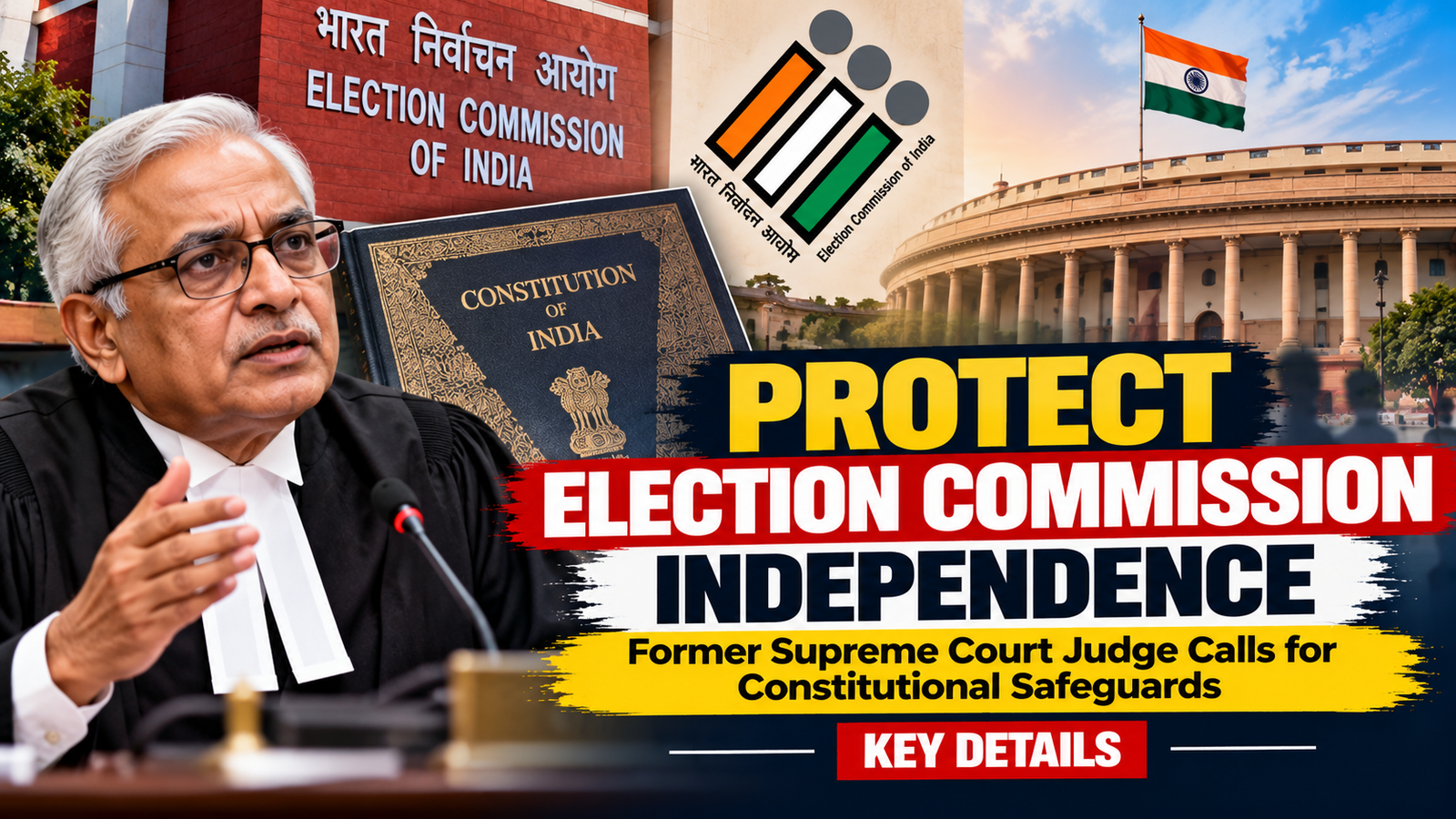
Former Supreme Court judge Justice Kurian Joseph has called for stronger constitutional safeguards to protect the independence of the Election Commission of India (ECI). He argued that the appointment process and service conditions of Election Commissioners should be protected through the Constitution rather than being left primarily to parliamentary legislation.
His remarks were delivered during an online inaugural address at a discussion titled “Independence of Election Commission of India: Compromised?” organised by the Indian Association of Lawyers, Kerala, in Kochi on October 13, 2026.
The discussion took place amid public debate over voter-list revisions, electoral transparency, and demands for accountability from Chief Election Commissioner Gyanesh Kumar. <Cite refs={[“turn732757search0″,”turn732757search1”]}/>
Why Does Justice Kurian Joseph Want Constitutional Safeguards?
Justice Kurian Joseph argued that the Election Commission must have effective protections to preserve its integrity and independence.
He said that the appointment process and service conditions of Election Commissioners should be written into the Constitution through appropriate amendments. According to him, stronger constitutional protection could help reduce the risk of political interference and reinforce public confidence in the institution.
His argument centres on the principle that an independent election authority is essential for conducting elections that citizens can trust.
The Election Commission is responsible for supervising elections to Parliament, state legislatures, and the offices of the President and Vice-President. Its independence is therefore an important part of India’s constitutional framework. <Cite refs={[“turn732757search0″,”turn732757search3”]}/>
What Did the Former Supreme Court Judge Say About Democracy?
During his address, Justice Joseph raised concerns about public confidence in constitutional institutions. He referred to the responsibility of constitutional courts, particularly the Supreme Court, to safeguard the Constitution.
He also used the analogy of a watchdog to explain that constitutional institutions must do more than express concern when fundamental principles are perceived to be under threat.
His remarks reflected his view that institutions responsible for protecting democracy must be able to act effectively when their independence or integrity is questioned.
These were his stated views at the discussion, rather than a judicial ruling on the conduct of the Election Commission or any specific election official. <Cite refs={[“turn732757search1″,”turn732757search2”]}/>
Why Is the Election Commission’s Independence Important?
The Election Commission of India is a constitutional body established under Article 324 of the Constitution. It has responsibility for the superintendence, direction, and control of the preparation of electoral rolls and the conduct of elections within its constitutional mandate.
Its independence matters for several reasons.
1. Conducting Free and Fair Elections
Voters need confidence that electoral procedures are administered impartially and that eligible citizens can participate in elections.
2. Maintaining Public Trust
Clear procedures and transparent decisions can help people understand how electoral processes work and how concerns can be raised.
3. Protecting Institutional Independence
Election authorities need to exercise their responsibilities according to the Constitution and applicable laws, without improper influence.
4. Ensuring Accountability
An independent institution must also operate within the law and remain subject to appropriate constitutional and legal scrutiny.
The Election Commission describes itself as a permanent constitutional body with responsibility for conducting elections under the Constitution and electoral laws. <Cite refs={[“turn732757search3”]}/>
How Are Election Commissioners Appointed in India?
The appointment of the Chief Election Commissioner and other Election Commissioners is governed by the Constitution and applicable legislation.
Article 324 provides the constitutional foundation for the Election Commission. The Chief Election Commissioner and other Election Commissioners are appointed by the President, subject to the relevant legal framework.
The Chief Election Commissioner also has a special removal safeguard: removal follows the same manner and grounds as those applicable to a Supreme Court judge. The Constitution provides a different removal arrangement for other Election Commissioners.
The Chief Election Commissioner and Other Election Commissioners (Appointment, Conditions of Service and Term of Office) Act, 2023, establishes a statutory framework covering appointments and service conditions.
Justice Joseph’s proposal calls for stronger constitutional protection for these matters. His suggestion would require appropriate constitutional changes and the applicable legal process; it is not an existing amendment simply because he has advocated it. <Cite refs={[“turn732757search3″,”turn732757search4”]}/>
What Is the Controversy Surrounding Electoral Roll Revisions?
The discussion in Kerala came amid wider concerns about the Special Intensive Revision (SIR) of electoral rolls and protests demanding accountability from Chief Election Commissioner Gyanesh Kumar.
Critics have raised concerns about the removal of names from voter lists and whether the process provides adequate notice, verification, and opportunities for eligible voters to correct errors.
At the same discussion, former Kerala High Court judge K. Balakrishnan Nair criticised the removal of voters during the revision process, arguing that the procedures had violated principles of natural justice.
These statements represent the views expressed by the speakers. Specific claims about individual deletions or procedural violations should be assessed using the relevant records, Election Commission explanations, and any applicable court findings. <Cite refs={[“turn732757search0″,”turn732757search1”]}/>
What Did Other Speakers Say at the Kerala Discussion?
The programme also featured comments from former Kerala High Court judge K. Balakrishnan Nair and writer K. R. Meera.
Balakrishnan Nair focused on procedural fairness in the revision of electoral rolls and raised concerns about the treatment of voters.
Writer K. R. Meera expressed support for youth-led protests and described them as a way to defend democratic values and brotherhood.
The gathering reflected concerns among the speakers about electoral administration, institutional credibility, and citizen participation. Their views formed part of a wider public debate about how constitutional institutions should operate and be held accountable. <Cite refs={[“turn732757search0″,”turn732757search2”]}/>
Could Constitutional Amendments Strengthen the ECI?
Justice Joseph’s proposal centres on whether constitutional amendments could provide more durable safeguards for the Election Commission’s independence.
Potential areas for debate include the appointment process, service conditions, removal protections, and safeguards against improper influence.
However, any proposed amendment would need to be examined in detail. Constitutional protection must be considered alongside accountability, transparency, and the practical functioning of the Commission.
The proposal also raises a broader constitutional question: how should India balance parliamentary lawmaking with institutional protections intended to ensure that election administration remains impartial?
No constitutional change follows automatically from a public speech. Any amendment would need to pass through the prescribed constitutional process.
Conclusion
Justice Kurian Joseph’s call for constitutional safeguards has brought renewed attention to the independence of the Election Commission of India.
His proposal is that the appointment process and service conditions of Election Commissioners should receive stronger protection under the Constitution. The remarks came amid debate over electoral-roll revisions and public confidence in election administration.
The discussion highlights the importance of free and fair elections, transparent procedures, institutional independence, and accountability. Any future changes will depend on further public debate, legislative action, and the constitutional process.
Frequently Asked Questions (FAQs)
1. Who called for constitutional safeguards for the Election Commission of India?
Former Supreme Court judge Justice Kurian Joseph called for constitutional amendments to strengthen the Election Commission’s independence.
2. What safeguards did Justice Kurian Joseph propose?
He proposed that the appointment process and service conditions of Election Commissioners should be protected directly by the Constitution.
3. Why is the Election Commission of India important?
The ECI oversees electoral rolls and conducts elections to Parliament, state legislatures, and the offices of the President and Vice-President within its constitutional mandate.
4. What is Article 324 of the Indian Constitution?
Article 324 establishes the constitutional framework for the Election Commission and gives it responsibility for the superintendence, direction, and control of elections.
5. Who appoints the Chief Election Commissioner?
The President of India appoints the Chief Election Commissioner under the applicable constitutional and legal framework.
6. What is the Special Intensive Revision of electoral rolls?
It is a process for reviewing and updating voter registration records. Debate has focused on implementation, verification, and safeguards for eligible voters.
7. Has Justice Kurian Joseph’s proposal become law?
No. His remarks were a proposal for constitutional change. Any amendment would need to follow the constitutionally prescribed process.
8. When did Justice Kurian Joseph make these remarks?
He delivered his address at a discussion organised by the Indian Association of Lawyers, Kerala, on October 13, 2026.
This article is based on published reports available on October 14, 2026. Consult official Election Commission publications and subsequent reporting for further developments.
