
Trust plays an important role in everyday life. People rely on doctors for healthcare, scientists for reliable knowledge and teachers for education. However, public confidence varies significantly across professions, particularly when politics, media and social influence are involved.
The Most Trusted Professions 2026 rankings published by Visual Capitalist, based on the Ipsos Global Trustworthiness Index 2026, reveal a clear divide in public confidence. Doctors, scientists and teachers occupy the top three positions, while politicians and social media influencers rank among the least trusted groups.
The survey covered 23,537 adults across 31 countries, offering an international view of how people perceive different professions. The results also highlight differences between people working in similar fields, including government officials and ministers, as well as television news anchors and social media influencers.
Most Trusted Professions in 2026: Key Findings
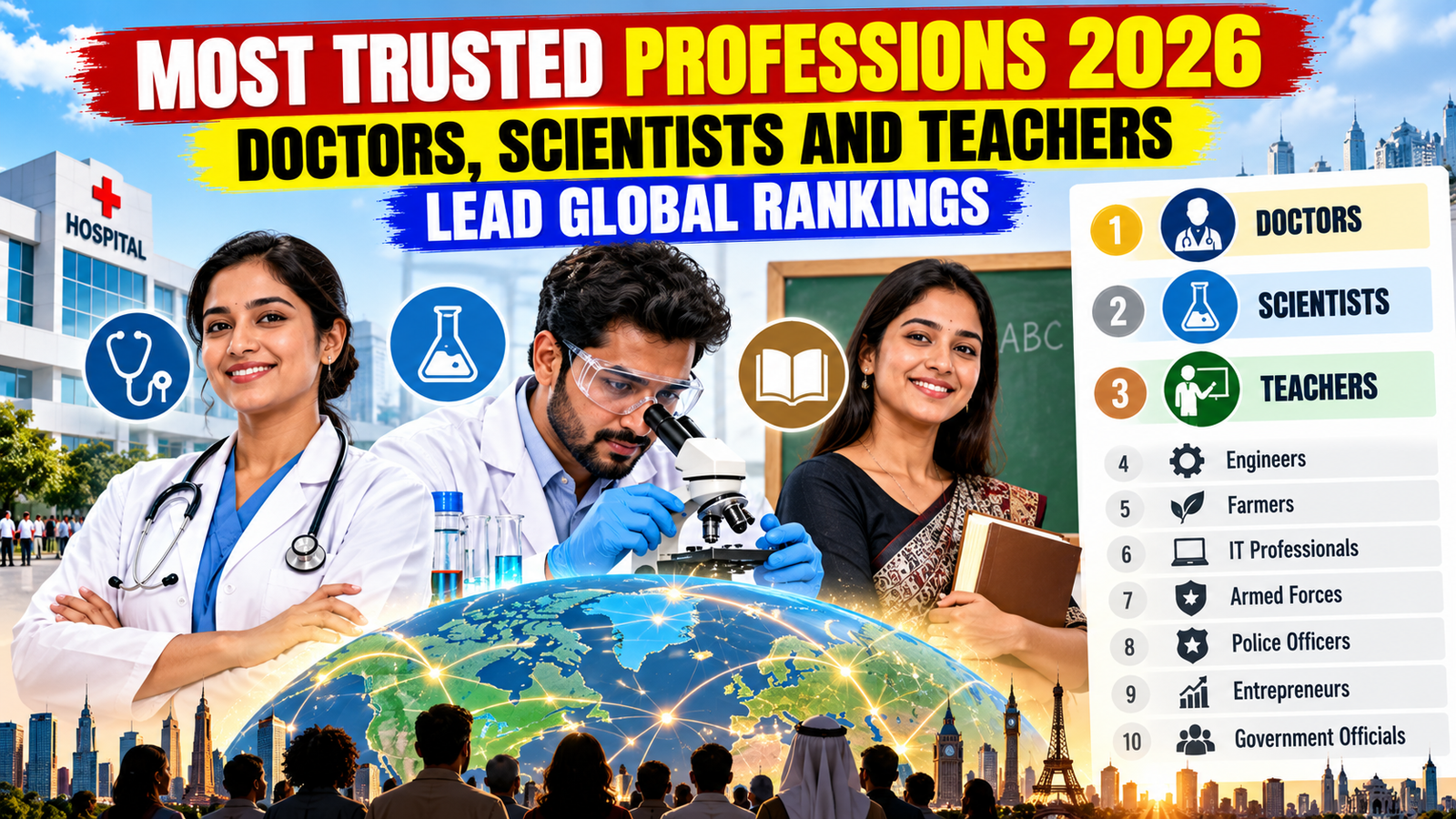
According to the Visual Capitalist ranking, doctors recorded the highest net trust score, followed closely by scientists and teachers.
The three leading professions also showed remarkable consistency across countries. They occupied the top three positions in 27 of the 31 countries surveyed, suggesting that healthcare, scientific knowledge and education enjoy broad public confidence.
Here are the top 10 professions and groups according to their net trust scores.
| Rank | Profession | Net trust score |
|---|---|---|
| 1 | Doctors | +43 |
| 2 | Scientists | +42 |
| 3 | Teachers | +37 |
| 4 | Armed forces | +16 |
| 5 | Personal trainers | +10 |
| 6 | Tech entrepreneurs | +6 |
| 7 | Judges | +5 |
| 8 | Police | +5 |
| 9 | Lawyers | 0 |
| 10 | Pollsters | -2 |
Source: Visual Capitalist, based on the Ipsos Global Trustworthiness Index 2026.
These scores represent the difference between the percentage of respondents who consider a profession trustworthy and the percentage who consider it untrustworthy. They are percentage-point balances, not the percentage of people who trust each profession.
1. Doctors Rank as the Most Trusted Profession
Doctors lead the 2026 global rankings with a net trust score of +43 percentage points.
Healthcare professionals regularly help people make important decisions about illness, treatment and prevention. Their work involves specialised knowledge and direct responsibility for patient care, making public confidence in medical advice particularly important.
Ipsos reported that 58% of respondents across the surveyed countries considered doctors trustworthy. This placed the medical profession ahead of scientists and teachers in the overall trust assessment.
However, trust does not mean every doctor or medical institution receives the same level of confidence. Individual experiences, access to healthcare and the quality of communication can all influence how people view medical professionals.
2. Scientists Remain Close Behind Doctors
Scientists ranked second with a net trust score of +42, just one percentage point behind doctors.
Scientific research contributes to developments in medicine, technology, agriculture, climate research and many other fields. People also rely on scientists to interpret evidence and explain complex questions.
The results suggest that scientific expertise continues to receive substantial public confidence internationally.
Nevertheless, scientific findings can be misunderstood or communicated poorly. Clear explanations, transparent methods and evidence-based conclusions remain important for maintaining that confidence.
3. Teachers Hold the Third Position
Teachers secured third place with a net trust score of +37.
Teachers influence education, skills development and the opportunities available to future generations. Their role extends beyond classroom instruction to helping students develop critical thinking and understand the world around them.
The strong ranking of teachers alongside doctors and scientists indicates that professions associated with knowledge and public service remain highly trusted in many countries.
The gap between teachers and the armed forces, which ranked fourth at +16, was 21 percentage points.
4. Armed Forces Rank Fourth
The armed forces received a net trust score of +16, placing them fourth in the global ranking.
This score was considerably lower than those of doctors, scientists and teachers, but it remained positive. The result indicates that trust exceeded distrust for this group across the survey’s overall country average.
Public confidence in military institutions can vary depending on national circumstances, historical experiences and perceptions of their role in society. Therefore, the international average should not be interpreted as representing every country’s opinion.
5. Technology Entrepreneurs Receive Positive Trust Scores
Tech entrepreneurs ranked sixth with a net trust score of +6. Personal trainers placed fifth at +10.
The results indicate that respondents were, on balance, more likely to trust tech entrepreneurs than distrust them. This is notable because technology companies increasingly influence communication, education, business and everyday life.
However, trust in entrepreneurs does not automatically translate into trust in every technology product or company. Questions about privacy, transparency, online safety and artificial intelligence can affect public attitudes towards the technology sector.
The 2026 Ipsos index also examined trust in AI chatbots for the first time. Across the 31 countries, 23% of respondents considered AI chatbots trustworthy, while 40% considered them untrustworthy.
Which Professions Are the Least Trusted in 2026?
At the other end of the ranking, politicians, social media influencers and government ministers recorded strongly negative net trust scores.
| Rank from top | Profession or group | Net trust score |
|---|---|---|
| 18 | Government ministers | -37 |
| 19 | Social media influencers | -44 |
| 20 | Politicians | -48 |
Source: Visual Capitalist, based on Ipsos data.
Politicians ranked last with a net trust score of -48. Social media influencers followed at -44, while government ministers recorded -37.
The findings point to a significant trust gap between professions associated with knowledge and public service and groups associated with political leadership or online influence.
However, the rankings measure public perceptions. They do not establish that every person working in a particular profession is trustworthy or untrustworthy.
Why Do Politicians Rank at the Bottom?
Politicians recorded the lowest net trust score in the survey. According to the figures reported by Visual Capitalist, 13% of respondents considered politicians trustworthy, while 61% considered them untrustworthy.
These results indicate a substantial difference between positive and negative perceptions.
Public confidence in political leaders may be influenced by views about accountability, transparency, policy decisions and whether elected representatives fulfil their promises. However, the survey figures alone cannot establish which factors caused the results.
The findings also demonstrate why national context matters. Political systems, public expectations and recent events differ between countries, meaning the global average cannot explain every country’s experience.
Why Are Social Media Influencers Among the Least Trusted?
Social media influencers recorded a net trust score of -44, placing them second from the bottom.
Influencers play a growing role in entertainment, product promotion, lifestyle content and online discussions. Their audiences may value their personal recommendations, but commercial sponsorships and undisclosed advertising can create questions about credibility.
The survey measures general perceptions of influencers as a group. It does not evaluate individual creators, specific platforms or the accuracy of particular posts.
The result also highlights the importance of checking sources before accepting information shared online, especially when content includes product claims, financial advice or health recommendations.
Government Officials Score Higher Than Ministers
One of the most notable findings concerns the difference between government officials and government ministers.
Government officials and civil servants recorded a net trust score of -9, compared with -37 for government ministers. This created a 28-percentage-point gap between the two groups.
The figures suggest that respondents distinguish between public administration and political leadership.
Civil servants generally carry out administrative responsibilities, while ministers are political leaders involved in policy direction and government decisions. Although the groups operate within the same broader system, the survey results show that they receive different levels of public confidence.
The difference does not establish why respondents hold these views, but it illustrates that trust can vary considerably even among people working in government.
How Does the Media Perform in the Trust Rankings?
The media-related results also reveal differences between professions.
Television news anchors recorded a net trust score of -3, while journalists scored -10. Social media influencers ranked considerably lower at -44.
Advertising executives received a score of -26, reflecting another area where distrust exceeded trust in the overall survey.
These results should not be treated as a direct measure of the accuracy of every news report or advertisement. Instead, they reflect respondents’ general perceptions of these professional groups.
For readers, the practical lesson is to evaluate information carefully, compare reliable sources and distinguish verified reporting from opinion, advertising and unsupported claims.
How Was the Most Trusted Professions 2026 Ranking Calculated?
The ranking is based on the Ipsos Global Trustworthiness Index 2026, which asked respondents whether various professions and groups were trustworthy or untrustworthy in their country.
The survey included 23,537 online adults across 31 countries. Fieldwork took place between June 19 and July 3, 2026.
The net trust score is calculated by subtracting the percentage who consider a profession untrustworthy from the percentage who consider it trustworthy.
For example, a score of +43 means the share expressing trust exceeds the share expressing distrust by 43 percentage points. It does not mean that 43% of respondents trust that profession.
The results represent an equal-weight average across the 31 surveyed countries, rather than a population-weighted estimate of the entire world’s population. This distinction is important when interpreting the international ranking.
What Do the 2026 Trust Rankings Tell Us?
The 2026 findings show that public trust varies substantially across professions. Doctors, scientists and teachers lead the rankings, while politicians and social media influencers face the largest trust deficits among the 20 groups included in the Visual Capitalist comparison.
The differences between government officials and ministers, and between television news anchors and influencers, also show that people do not necessarily view every profession within the same sector equally.
The results offer a useful snapshot of public opinion across 31 countries. However, they should be understood as perceptions recorded during a specific survey period, not as a permanent assessment of every professional or institution.
Ultimately, trust depends on more than a job title. Credibility, transparency, accountability and the quality of information people receive can all shape how professions are viewed.
Sources:
- Visual Capitalist: Ranked — The Most and Least Trusted Professions in 2026
- Ipsos: Global Trustworthiness Index 2026
Frequently Asked Questions
1. What is the most trusted profession in 2026?
Doctors ranked first in the Visual Capitalist comparison of the Ipsos Global Trustworthiness Index 2026, with a net trust score of +43 percentage points.
2. Which professions rank second and third?
Scientists ranked second with +42, while teachers ranked third with +37.
3. What is the least trusted profession in 2026?
Politicians ranked last among the 20 groups in the Visual Capitalist comparison, with a net trust score of -48.
4. How trusted are social media influencers?
Social media influencers recorded a net trust score of -44, placing them second from the bottom in the ranking.
5. How many people participated in the survey?
Ipsos surveyed 23,537 adults across 31 countries between June 19 and July 3, 2026.
6. What does net trust score mean?
Net trust score is the percentage of respondents who consider a profession trustworthy minus the percentage who consider it untrustworthy. A positive score indicates that trust exceeds distrust.
7. Does the ranking represent every country equally?
The published global scores are equal-weight averages across the 31 surveyed countries. They are not population-weighted estimates of every person worldwide.
8. Where can readers find the original report?
Readers can consult the Visual Capitalist ranking and the official Ipsos Global Trustworthiness Index 2026.
