


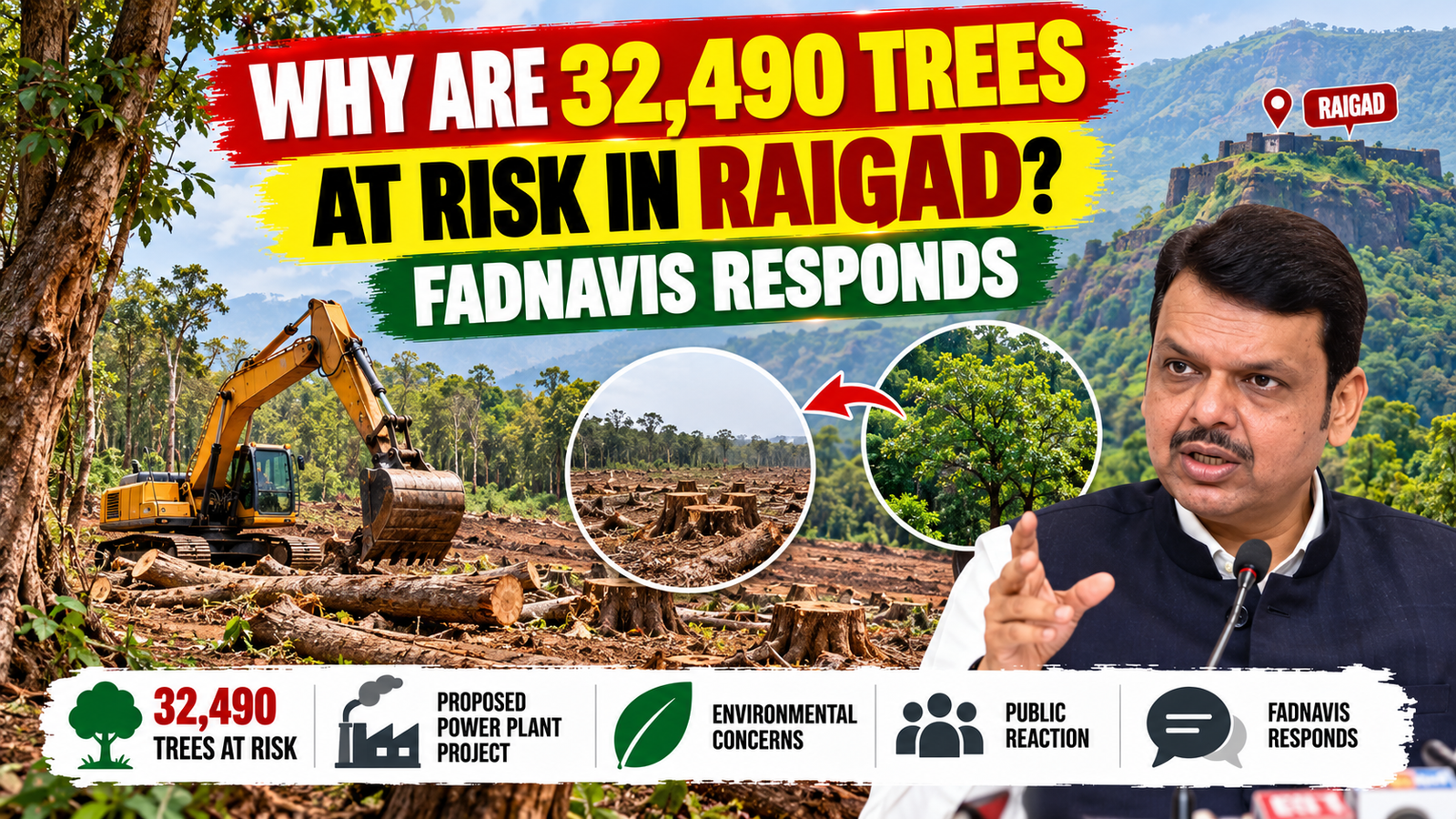
The Raigad tree cutting controversy has sparked widespread concern in Maharashtra after permission was granted to fell 32,490 trees for a proposed 3,000 MW pumped-storage hydropower project in Karjat taluka. The project, associated with Torrent Power, has drawn attention from local residents, environmental groups and political leaders.
Maharashtra Chief Minister Devendra Fadnavis has defended the project, stating that the required procedures and approvals were followed. He has also argued that the state needs clean-energy infrastructure to meet its growing electricity demand.
However, residents and environmental activists have questioned the potential impact on forests, wildlife habitats and local water resources.
The controversy took another turn on October 27, 2026, when a report by The Times of India said the plan to cut the trees had been halted amid protests. Officials had not confirmed whether the halt was permanent.
What Is the Raigad Tree Cutting Controversy About?
The Raigad tree cutting controversy centres on the proposed Saidongar-I pumped-storage hydropower project in Karjat, Raigad district, Maharashtra.
According to media reports, a forest department notice dated October 14, 2026, directed the felling of 32,490 trees associated with the project. The affected land includes reserved, private and protected forest areas across approximately 576 acres, according to the report.
The proposed development has raised questions about how much forest land will be affected and what safeguards will be used to protect the surrounding ecosystem.
Local residents have expressed concerns about tree removal, while environmental campaigners have called for greater transparency around the project’s approvals and environmental assessments.
The controversy is not simply about the number of trees. It also concerns the balance between electricity infrastructure, environmental protection and the rights and concerns of communities living near the project.
Why Does the Karjat Project Require 32,490 Trees to Be Cut?
Large infrastructure projects can require land for reservoirs, access roads, construction areas and supporting facilities. In the Karjat project, the reported tree-felling permission relates to land required for the planned pumped-storage facility.
Trees help maintain soil stability, support biodiversity and provide habitats for birds, insects and other wildlife. Forests also influence local drainage and water systems.
Removing a large number of trees may therefore create environmental concerns that extend beyond the immediate construction site. The actual impact depends on the location of the affected trees, the condition of the forest, the construction plan and the effectiveness of mitigation measures.
Environmental assessments are important because they help identify potential risks before construction proceeds. They can also establish conditions for protecting sensitive areas and monitoring the project’s effects.
The scale of the proposed tree removal has made these questions central to the public debate in Raigad.
What Did Devendra Fadnavis Say About the Tree Cutting?
Chief Minister Devendra Fadnavis defended the proposed project amid criticism from opposition leaders and environmental groups.
According to media reports published on October 26, 2026, Fadnavis said the necessary legal procedures had been followed and that hearings and reviews had taken place over approximately 18 months.
He described the project as an environmentally beneficial source of energy and argued that it could help Maharashtra meet its electricity requirements.
The chief minister also disputed claims about the project’s proximity to Bhimashankar Wildlife Sanctuary. He and the company said the project site would be around 16 kilometres away.
Critics, however, have questioned whether the environmental consequences and objections raised by local residents have been adequately addressed.
The government’s position is that the project has received the required approvals. The objections concern the environmental impact, the approval process and the consequences of large-scale tree removal. These positions should be assessed using official documents and environmental records.
What Is the 3,000 MW Karjat Hydropower Project?
The proposed Saidongar-I project is a 3,000 MW pumped-storage hydropower facility planned in Karjat taluka.
Pumped-storage hydropower works by moving water between two reservoirs at different elevations. When electricity is available in excess, power is used to pump water to the upper reservoir. When electricity demand rises, the stored water flows back down through turbines to generate electricity.
This process allows the power system to store energy and use it later. It can be particularly useful when solar and wind generation fluctuates throughout the day.
Unlike a conventional power plant that primarily generates electricity from a fuel source, pumped storage consumes electricity to move water and recovers part of that energy when generating power.
Supporters argue that the Karjat project could improve grid flexibility and help meet peak electricity demand. However, its overall environmental impact depends on its design, land requirements, water management and construction footprint.
The potential benefits of energy storage must therefore be considered alongside the environmental and social effects of building the facility.
Why Are Local Residents and Environmentalists Opposing the Project?
The proposed tree removal has prompted concerns about forest conservation, biodiversity and the impact on local communities.
Residents have questioned whether their objections were adequately considered during the approval process. Environmental campaigners have also called for greater transparency about public hearings, environmental assessments and the project’s land requirements.
Opposition leaders, including Shiv Sena (UBT) MLA Aaditya Thackeray and NCP (SP) leader Rohit Pawar, have criticised the proposed tree felling. Maharashtra Navnirman Sena chief Raj Thackeray also announced plans to visit Karjat amid the controversy.
Some critics have questioned whether the project could be developed with a smaller environmental footprint or at an alternative location.
These objections do not, by themselves, establish that the project has violated the law. They do, however, highlight the need for clear information about the approvals, environmental safeguards and concerns raised by affected communities.
Transparent documentation can help the public understand what was approved, which conditions apply and how compliance will be monitored.
Is the Project Located Near Bhimashankar Wildlife Sanctuary?
The project’s location in the Sahyadri-Western Ghats region has contributed to concerns about its possible environmental effects.
Critics have raised questions about the project’s proximity to Bhimashankar Wildlife Sanctuary and the potential impact on nearby forest ecosystems.
Fadnavis and Torrent Power have disputed claims that the project is located within the sanctuary, stating that the site is approximately 16 kilometres away.
However, a project’s distance from a protected area does not automatically establish whether it will have no ecological impact. Environmental assessments may also need to consider water flows, wildlife movement, forest connectivity and other effects beyond protected-area boundaries.
The project’s official maps, environmental clearance documents and applicable conditions are important sources for evaluating these questions.
Has the Tree Cutting in Raigad Been Stopped?
A report published by The Times of India on October 27, 2026, stated that the plan to cut 32,490 trees had been halted amid protests by residents and opposition groups.
A forest department official reportedly said the decision was taken because tensions had increased around the project site.
The report did not establish whether the halt was permanent. It also did not confirm that the entire hydropower project had been cancelled or that all existing permissions had been revoked.
This distinction is important. A pause in tree-felling activity does not necessarily mean that a project’s construction plans have been abandoned.
The next developments will depend on official announcements from the relevant authorities, any revised directions and the status of the project’s approvals.
Readers should check for further government or forest department updates before treating the reported halt as a final decision.
How Could the Project Affect Maharashtra’s Clean-Energy Plans?
Maharashtra needs reliable electricity for households, businesses, industry and public infrastructure. As solar and wind power become more important, the state also needs ways to manage changes in electricity generation.
Pumped-storage facilities can help by storing energy when supply is high and releasing electricity when demand increases. This can improve flexibility in the power system.
However, clean-energy infrastructure still requires careful planning. Projects involving forest land can raise questions about biodiversity, water resources, land use and the livelihoods of nearby communities.
A balanced assessment should consider both the electricity benefits and the environmental costs. It should also examine whether design changes, alternative locations or additional safeguards could reduce harm.
The Raigad controversy demonstrates why environmental transparency and meaningful public consultation are important when large infrastructure projects are planned.
What Happens Next in the Raigad Tree Cutting Case?
The immediate question is whether the reported halt to tree felling will continue and whether the authorities will announce further steps concerning the project.
Several issues remain important:
- Official clarification: Whether the forest department will confirm the current status of the tree-felling permission.
- Environmental safeguards: How the project will address concerns about forests, wildlife and water resources.
- Public consultation: Whether residents’ objections have been documented and answered.
- Approval conditions: Whether the project is complying with the relevant environmental and forest-related requirements.
- Future construction: Whether the project will proceed as planned or undergo changes after further review.
These remain open questions rather than confirmed outcomes. Any final decision should be checked against official announcements and the project’s relevant documents.
Conclusion
The Raigad tree cutting controversy has highlighted the challenge of balancing energy development with forest conservation. The proposed 3,000 MW Karjat pumped-storage project has drawn attention because of the reported permission to fell 32,490 trees.
Devendra Fadnavis has defended the project on the grounds of legal approvals and Maharashtra’s energy needs. Local residents, environmentalists and opposition leaders have raised concerns about tree removal and the potential effects on the surrounding ecosystem.
The reported halt to tree felling on October 27, 2026, represents an important development, but it does not establish that the project has been permanently cancelled.
The key issues now are transparency, environmental protection and the authorities’ next decisions. The outcome will help determine how the project moves forward and how concerns raised by local communities are addressed.
Sources:
- India TV: Controversy Over Cutting More Than 32,000 Trees for Power Plant in Raigad
- The Times of India: Plan to Cut 32,490 Karjat Trees Halted
- Hindustan Times: Fadnavis Defends Torrent Power Project
Frequently Asked Questions
1. Why are 32,490 trees at risk in Raigad?
The trees are associated with land approved for the proposed 3,000 MW Saidongar-I pumped-storage hydropower project in Karjat taluka.
2. What did Devendra Fadnavis say about the tree cutting?
Fadnavis said the prescribed procedures had been followed and defended the project as a source of clean energy for Maharashtra.
3. Which company is developing the Karjat hydropower project?
Torrent Power is associated with the proposed project.
4. What is the capacity of the proposed project?
The proposed pumped-storage hydropower facility has a planned capacity of 3,000 MW.
5. Has the tree cutting been stopped?
A report published on October 27, 2026, said the plan to cut the trees had been halted amid protests. The report did not confirm whether the halt was permanent.
6. Why are environmentalists concerned about the project?
Their concerns include forest loss, possible effects on biodiversity and water resources, and whether local objections were adequately considered.
7. Is the project inside Bhimashankar Wildlife Sanctuary?
Fadnavis and Torrent Power have said the project is approximately 16 kilometres away and outside the sanctuary. Official maps and environmental documents are needed to assess the precise location and applicable safeguards.
8. Why is pumped-storage hydropower important?
Pumped-storage hydropower stores energy by pumping water uphill and generates electricity when water flows back down. It can help balance electricity supply and demand, particularly when renewable generation fluctuates.
