


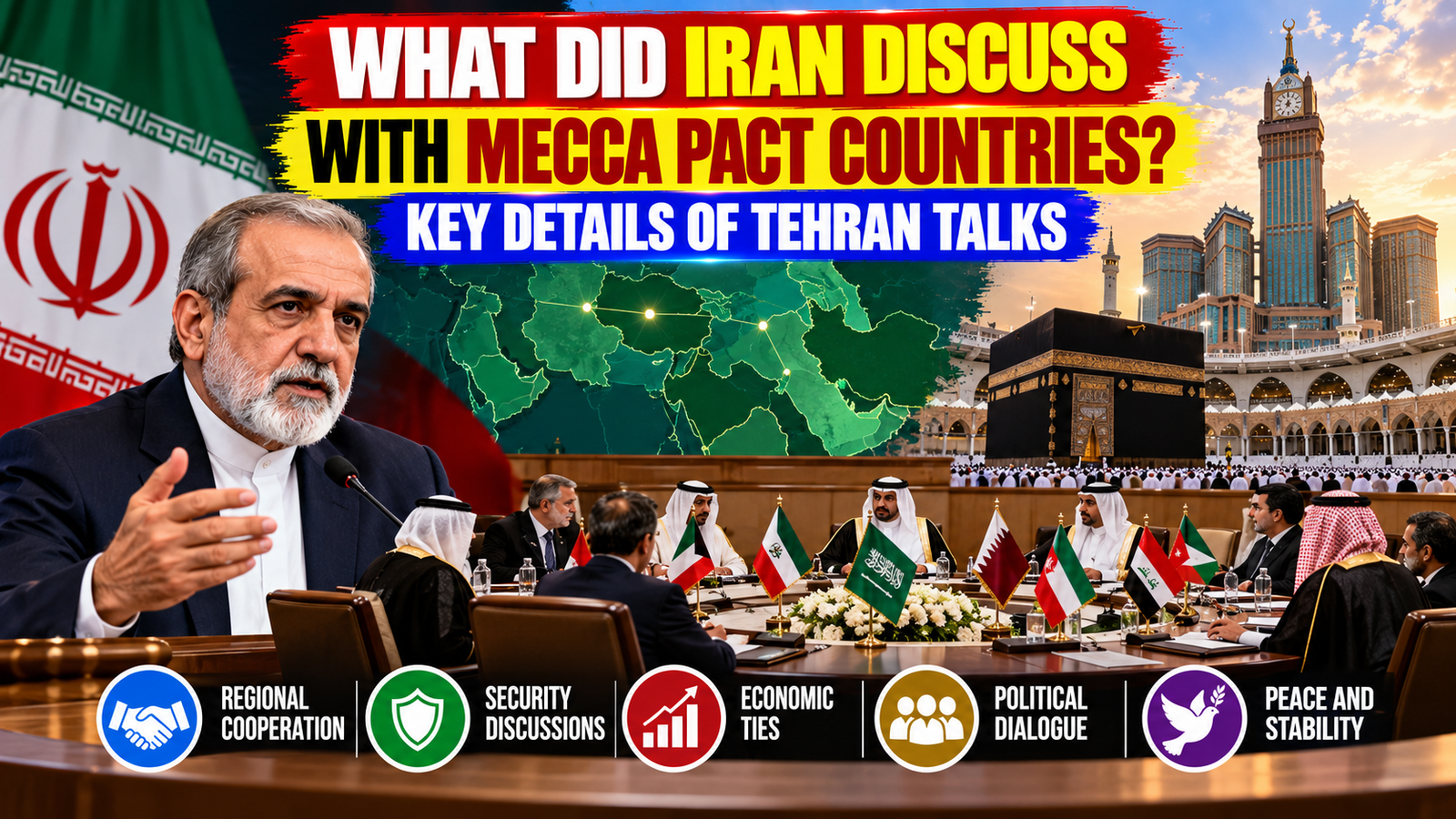
Iran has described its latest discussions with Saudi Arabia, Pakistan and Turkey as positive, raising hopes for renewed diplomatic efforts to reduce tensions across the Middle East. The meeting took place in Tehran on October 26, 2026, amid concerns that the ongoing regional conflict could escalate again.
Iranian security chief Mohsen Rezaei said that “very good discussions” had taken place with senior representatives from the three countries. The talks focused on regional security, cooperation and efforts to prevent further escalation.
The meeting was significant because it brought Iranian officials together with representatives of the three countries that signed a defence pact in Mecca in August. However, the discussions ended without a concrete public agreement, and the countries said they would continue their talks.
What Happened During the Iran-Mecca Pact Talks?
Senior officials from Saudi Arabia, Pakistan and Turkey travelled to Tehran for discussions with Iranian leaders. The visit was described as part of diplomatic efforts to de-escalate the current regional crisis.
The delegations met Iranian President Masoud Pezeshkian and Foreign Minister Abbas Araghchi. Iran’s Supreme National Security Council chief, Mohsen Rezaei, also held discussions with the visiting officials.
According to the report published by NDTV and Agence France-Presse on October 27, the meeting was the first joint visit to Tehran by representatives of the three Mecca defence pact countries since the alliance was formed in August.
Iranian state television reported that the participants agreed to continue discussions on regional cooperation, peace and security.
Although Tehran described the talks positively, no detailed joint agreement was publicly announced at the conclusion of the meeting.
Why Did Iran Call the Discussions “Very Good”?
Mohsen Rezaei said the discussions had taken place in a positive atmosphere. He also suggested that a new regional environment was emerging through dialogue between the countries.
Rezaei emphasised the importance of regional countries taking responsibility for their own security and preventing foreign interference.
His remarks reflected Iran’s stated preference for regional cooperation in addressing security challenges. However, a positive description of diplomatic talks does not necessarily mean that the participating countries have resolved their differences.
The next stage of discussions will be important in determining whether the meeting leads to practical agreements or further diplomatic engagement.
Which Countries Participated in the Tehran Meeting?
The discussions involved Iran and representatives from three countries associated with the Mecca defence pact.
Iran
Iran hosted the meeting as regional tensions remained high. President Masoud Pezeshkian, Foreign Minister Abbas Araghchi and security chief Mohsen Rezaei were among the Iranian officials involved.
Tehran has called for regional countries to cooperate on security and has opposed foreign intervention in regional affairs.
Saudi Arabia
Saudi Arabia was represented by Defence Minister Prince Khalid bin Salman. His participation was notable because relations between Riyadh and Tehran have long been shaped by competing regional security interests.
The Saudi delegation’s visit formed part of efforts to contain tensions and encourage dialogue.
Pakistan
Pakistan’s Army Chief, General Asim Munir, participated in the meeting. Pakistan has also played a role in diplomatic contacts involving Iran and the United States.
Its involvement in the Tehran discussions highlighted Islamabad’s position as a regional participant seeking continued engagement between the parties.
Turkey
Turkey was represented by intelligence chief Ibrahim Kalin. Ankara’s participation brought another influential regional country into the discussions on security and de-escalation.
The presence of all three Mecca pact countries made the meeting an important diplomatic development, although the outcome remained limited to an agreement to continue talks.
What Is the Mecca Defence Pact?
The Mecca defence pact is a security arrangement formed by Saudi Arabia, Pakistan and Turkey in August 2026.
The agreement provides a framework for cooperation among its members on defence and regional security. It emerged at a time when concerns about military escalation and regional instability were growing.
The Tehran meeting did not make Iran a member of the pact. Instead, it brought Iranian officials into discussions with representatives of the three countries that signed the agreement.
This distinction is important. Dialogue with the pact’s members does not automatically mean that Iran has joined the alliance or accepted its defence commitments.
The talks indicate that regional security discussions can involve countries outside a formal defence arrangement when wider stability is at stake.
Why Are Middle East Tensions Rising Again?
The meeting took place amid fears that hostilities involving Iran, the United States and Israel could resume or intensify.
Officials and political leaders have issued warnings about the possibility of further military action. These statements have contributed to uncertainty across the region.
The conflict has also affected security calculations in neighbouring countries, particularly where attacks on infrastructure and cross-border threats have increased concerns.
United Nations Secretary-General António Guterres warned that further escalation needed to be avoided. He stressed the risks associated with major military attacks involving Iran and Gulf countries.
These concerns help explain why regional governments have continued diplomatic contacts even as tensions remain unresolved.
How Do Houthi Attacks Affect Regional Security?
The discussions also took place against a backdrop of attacks attributed to Yemen’s Houthi movement, which is aligned with Iran.
Saudi Arabia has faced missile and drone threats, including reported attacks affecting the Riyadh region. Saudi-led coalition forces said they intercepted three Houthi-launched drones over southern Saudi Arabia and the Riyadh region.
These developments have increased security concerns for Saudi Arabia and its regional partners.
The relationship between Iran and the Houthis is an important part of the wider regional security picture. However, the reported Tehran meeting did not publicly establish a comprehensive agreement on how the participants would respond to Houthi attacks.
Any future security arrangement would depend on further discussions and decisions by the countries involved.
What Role Are Pakistan and Qatar Playing in Diplomacy?
Pakistan has been involved in diplomatic efforts aimed at reducing tensions between Iran and the United States. Its participation in the Tehran meeting added another regional dimension to those efforts.
Qatar has also been active in mediation. According to the NDTV report, a Qatari delegation visited Tehran shortly before the meeting, as part of continuing diplomatic contacts.
These efforts suggest that several regional governments are seeking ways to prevent further escalation.
However, mediation does not guarantee an agreement. Major differences over security, military operations and sanctions can make negotiations difficult, and the outcome depends on the willingness of all parties to reach workable arrangements.
Did the Iran-Mecca Pact Meeting Produce an Agreement?
The meeting ended without a detailed public announcement of a new agreement.
Iranian state media reported that the participants agreed to continue discussions to strengthen cooperation among the four countries, particularly on regional peace and security.
This is a diplomatic commitment to further engagement, rather than confirmation that the wider conflict has been resolved.
The key questions remain whether the countries can agree on practical steps to reduce military risks, whether further meetings will take place and whether their discussions will produce measurable results.
Until further details are released, the meeting should be understood as an attempt to maintain dialogue amid regional uncertainty.
What Could Happen Next?
The immediate next step is likely to be continued diplomatic engagement, consistent with the participants’ reported agreement to keep talking.
Several issues could shape future discussions:
- Regional de-escalation: Whether the countries can reduce the risk of renewed military confrontation.
- Security cooperation: Whether they can identify shared priorities while maintaining different national positions.
- Iran-US relations: Whether diplomatic channels can help address the broader confrontation involving Washington and Tehran.
- Gulf security: Whether attacks and threats affecting Saudi Arabia and neighbouring countries can be contained.
- Future negotiations: Whether additional meetings lead to concrete commitments rather than general statements.
These are possible areas for further diplomacy, not confirmed outcomes of the October 26 meeting.
The importance of the talks will ultimately depend on what the participating countries do after the initial discussions.
Conclusion
Iran’s description of the Tehran meeting as “very good” points to a positive tone in its discussions with Saudi Arabia, Pakistan and Turkey. The meeting brought representatives of the three Mecca defence pact countries together with Iranian leaders at a time of heightened regional tension.
The participants reportedly agreed to continue discussions on regional cooperation, peace and security. However, no detailed public agreement emerged from the meeting, and major security challenges remain unresolved.
For now, the talks represent a diplomatic effort to keep communication open and explore ways to prevent further escalation in the Middle East. Their long-term significance will depend on whether future discussions produce practical steps towards regional stability.
Source: NDTV — Iran Says “Very Good Discussions” Held With Mecca Pact Countries
Frequently Asked Questions
1. What did Iran say about the Mecca Pact talks?
Iranian security chief Mohsen Rezaei described the discussions with Saudi Arabia, Pakistan and Turkey as “very good” and said he sensed a positive atmosphere.
2. When did the Iran-Mecca Pact meeting take place?
The meeting took place in Tehran on October 26, 2026.
3. Which countries participated in the talks?
Iran held discussions with representatives from Saudi Arabia, Pakistan and Turkey, the three countries associated with the Mecca defence pact.
4. Did the meeting produce a peace agreement?
No detailed public agreement was announced. The participants reportedly agreed to continue discussions on regional cooperation, peace and security.
5. What is the Mecca defence pact?
It is a security arrangement formed by Saudi Arabia, Pakistan and Turkey in August 2026 to strengthen defence cooperation among its members.
6. Why are the Tehran talks important?
The meeting took place amid concerns about renewed military escalation in the Middle East. Continued dialogue could provide an avenue for discussing regional security and reducing tensions.
7. Is Iran a member of the Mecca defence pact?
The reported meeting does not indicate that Iran has joined the pact. Iran participated in discussions with representatives of its three member countries.
8. What happens after the talks?
The countries have reportedly agreed to continue discussions. Whether those talks lead to concrete security arrangements or broader de-escalation remains uncertain.
